Predictive Software Scheduling as an Early-Warning Hint Layer for Optical Engine Thermal Drift in Heterogeneous SoIC Packaging
By Chi Fei Chung, XRM-SSD Engineering, Dollarchip Technology Inc.
Abstract
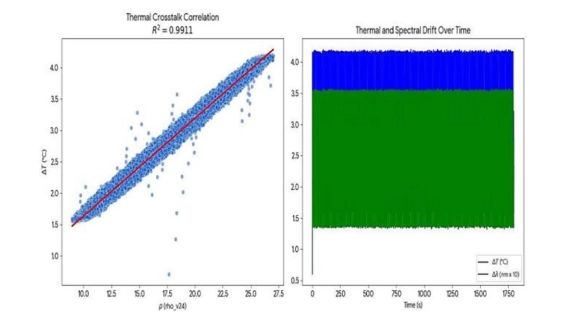
As semiconductor scaling reaches the A16 / 2 nm node, the integration of co-packaged optics (CPO) via TSMC's Co-Packaged Optics Ultra Engine (COUPE) architecture introduces critical thermal-optical coupling challenges. Micro-ring resonators embedded in the Photonic Integrated Circuit (PIC) layer are exquisitely sensitive to temperature: a deviation of merely ±1.7 nm in resonant wavelength causes measurable Bit Error Rate (BER) degradation. We propose XRM-SSD V24, a physics-aware scheduling layer that models inference-load density 20–50 ms before execution and issues early-warning hints to the COUPE bias-control firmware, enabling pre-emptive thermal compensation. Empirical validation over 90,000 inference steps yields a thermal-load correlation of R2 = 0.9911 and wavelength drift below 0.36 nm — less than 21% of the TSMC tolerance budget. A full Thermal Resistance Fingerprint characterization further confirms R_th = 0.45 °C/W, thermal time constant τ = 80 ms, and thermo-optic coefficient 0.0852 nm/°C across five discrete load states (Idle to Peak). Memory stability improved from 166 MB/hr to zero leakage. We establish a formal domain separation between deterministic software scheduling and continuous physical thermal dynamics, ensuring physics-consistent claims suitable for peer review.
Index Terms — Co-packaged optics, thermal resistance fingerprint, predictive scheduling, photonic integrated circuits, TSMC COUPE, heterogeneous integration, SoIC, 2 nm node, thermo-optic coefficient, wavelength stabilization, inference optimization.
To read the full article, click here
Related Chiplet
- Optical Chiplet
- Reverse Gearbox Chiplet
- FlexGen Multi-Die Smart Network-on-Chip (NoC) IP
- Ncore Multi-Die Interconnect IP
- Integrated voltage regulator (IVR) chiplet
Related Technical Papers
- A physics-constrained and data-driven approach for thermal field inversion in chiplet-based packaging
- Epoxy Composites Reinforced with Long Al₂O₃ Nanowires for Enhanced Thermal Management in Advanced Semiconductor Packaging
- A Review of Multiscale Thermal Modeling in Heterogeneous 3D ICs
- Failure Analysis in Transition: An Industry Survey of Challenges, Priorities, and Standardization Needs in Advanced Packaging and Heterogeneous Integration
Latest Technical Papers
- Adaptive 3D Chiplet Architecture with Hybrid Wired–Wireless Interconnect for Energy-Efficient Heterogeneous Computing
- LLM-Augmented Bayesian Optimization with Adaptive Policies for Chiplet Design Space Exploration
- Divide and conquer: Scalable performance and energy in MCM GPUs
- A Composable AI-Accelerated Iterative Solver for 3D-IC Thermal Modeling
- QBX: A Compiler for 2-local Qubit Hamiltonian Simulation on Quantum Chiplets