A Review of Multiscale Thermal Modeling in Heterogeneous 3D ICs
By Baibhari Priya Barua, Md Rahatul Islam Udoy, Ahmedullah Aziz
University of Tennessee, Knoxville, USA
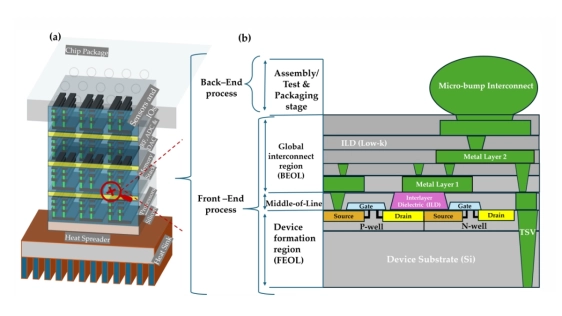
Abstract
Thermal behavior has become a first-order constraint in advanced 2.5D/3D integrated circuits (ICs) and heterogeneous packages. As power densities rise and multiple active dies are vertically integrated, heat removal paths become constricted, elevating junction temperatures, magnifying temperature gradients, and exacerbating reliability risks. This review synthesizes the physical mechanisms, modeling assumptions, and analysis methods that govern multiscale thermal transport in 3D ICs, with emphasis on interface-dominated conduction, material anisotropy, and strong electrothermal coupling. We unify device-to-system scales into a coherent framework, analyzing trade-offs among compact thermal models (CTMs), finite element/finite difference methods (FEM/FDM), Green's function and semi-analytical techniques, reduced-order and multi-fidelity methods, and physics-informed machine learning (PIML), while highlighting the central role of thermal boundary resistance (TBR) and variability in thermal interface materials (TIMs), the pitfalls of decoupled electrical/thermal analyses, and the need for rigorous validation against measurements. Finally, we outline practical design guidelines and a forward-looking research agenda that integrates physics-based modeling, data-driven surrogates, and in situ sensing to enable thermally aware co-optimization across the IC-package-system hierarchy.
To read the full article, click here
Related Chiplet
- Optical Chiplet
- Reverse Gearbox Chiplet
- FlexGen Multi-Die Smart Network-on-Chip (NoC) IP
- Ncore Multi-Die Interconnect IP
- Integrated voltage regulator (IVR) chiplet
Related Technical Papers
- Toward Digital Twins in 3D IC Packaging: A Critical Review of Physics, Data, and Hybrid Architectures
- Thermal Issues Related to Hybrid Bonding of 3D-Stacked High Bandwidth Memory: A Comprehensive Review
- Generative Design of Liquid-Cooling Channels for Thermal Management of 2.5D and 3D Integrated Advanced Packaging
- Recent Progress in Structural Integrity Evaluation of Microelectronic Packaging Using Scanning Acoustic Microscopy (SAM): A Review
Latest Technical Papers
- Adaptive 3D Chiplet Architecture with Hybrid Wired–Wireless Interconnect for Energy-Efficient Heterogeneous Computing
- LLM-Augmented Bayesian Optimization with Adaptive Policies for Chiplet Design Space Exploration
- Divide and conquer: Scalable performance and energy in MCM GPUs
- A Composable AI-Accelerated Iterative Solver for 3D-IC Thermal Modeling
- QBX: A Compiler for 2-local Qubit Hamiltonian Simulation on Quantum Chiplets