A physics-constrained and data-driven approach for thermal field inversion in chiplet-based packaging
By Yupeng Qi 1, Yue Wu 1, Jie Xiong 1, Shunbo Hu 1,2 and Deng Pan 1,3
1 Materials Genome Institute, Shanghai University, Shanghai 200444, China
2 Management and Ministry of Education Key Laboratory of Silicate Cultural Relics Conservation, Institute for the Conservation of Cultural Heritage, School of Cultural Heritage and Information Shanghai University, Shanghai 200444, China
3 Ministry of Education Key Laboratory of Silicate Cultural Relics Conservation, Shanghai University, Shanghai 200444, China
Abstract
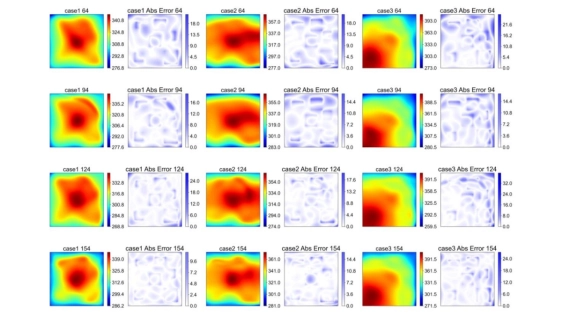
The chiplet-based packaging integrates multiple heterogeneous chiplets with distinct functionalities and materials as a promising alternative to traditional SoC designs, reducing manufacturing costs and improving chip yield. However, increased power density and deteriorating heat dissipation conditions severely affect the functionality and stability of such systems, whereas existing thermal field inversion methods often overlook the correlation between data constraints and physical constraints, leading to insufficient prediction accuracy. This paper proposes a method based on Region-Coupled Physics-Informed Neural Networks (RC-PINNs) to address the thermal field inversion of chiplet packaging using a small dataset. RC-PINN divides the solution domain into multiple regions based on material properties and incorporates physical constraints into the loss functions of each region to ensure the solutions comply with physical laws. Coupling between different regions is achieved through temperature and heat flux continuity conditions to maintain physical consistency. Additionally, a Gaussian Process Uncertainty-Guided Sampling (GP-UGS) method is developed for data augmentation, further improving prediction accuracy in data-sparse scenarios. Experimental results demonstrate that RC-PINN effectively solves the thermal field inversion for chiplet packaging, achieving an average relative error of less than 0.4% under limited data conditions, with a 40% improvement in performance over traditional neural network methods. The GP-UGS method further improves prediction accuracy and generalization, raising the R2 score to over 0.99 with only 64 observations.
Keywords: chiplet-based packaging; physics-informed neural network; thermal field inversion; small dataset; data augmentation
To read the full article, click here
Related Chiplet
- Optical Chiplet
- Reverse Gearbox Chiplet
- FlexGen Multi-Die Smart Network-on-Chip (NoC) IP
- Ncore Multi-Die Interconnect IP
- Integrated voltage regulator (IVR) chiplet
Related Technical Papers
- Generative Design of Liquid-Cooling Channels for Thermal Management of 2.5D and 3D Integrated Advanced Packaging
- Thermal Tuning Overhead in Wafer-Scale Optical Interconnects for LLM MoE Training: A Cross-Layer Analysis and Ferroelectric-Based Mitigation
- Predicting Cure Evolution and Thermal Endurance of a Highly Filled Epoxy Underfill for Advanced Packaging
- Epoxy Composites Reinforced with Long Al₂O₃ Nanowires for Enhanced Thermal Management in Advanced Semiconductor Packaging
Latest Technical Papers
- LLM-Augmented Bayesian Optimization with Adaptive Policies for Chiplet Design Space Exploration
- Divide and conquer: Scalable performance and energy in MCM GPUs
- A Composable AI-Accelerated Iterative Solver for 3D-IC Thermal Modeling
- QBX: A Compiler for 2-local Qubit Hamiltonian Simulation on Quantum Chiplets
- U-Can-Inject-Errors (UCIe): A Protocol-Aware Hardware Trojan for FPGA Chiplet Links