Thermo-mechanical reliability evaluation and comparative fatigue assessment of 2.5D chiplet packages with viscoelastic C4 underfill
By Peisheng Liu 1,2, Feiyu Qiang 1, Yaohui Deng 1, Jiajie Jin 1, Jinlan Wang 1,2
1 School of Microelectronics, Nantong University, China
2 Department of Information Technology, Xinglin College, Nantong University, China
Abstract
2.5D chiplet packaging is increasingly constrained by thermo-mechanical fatigue under thermal cycling. This work presents a case-oriented sequentially coupled thermo-mechanical finite-element evaluation that combines heat conduction, temperature-dependent constitutive laws, and a JEDEC-based environmental thermal-cycling profile in a representative package with viscoelastic underfill. The objective is to compare the relative influence of C4-underfill condition and solder-alloy selection under consistent modeling assumptions, rather than to establish a package-specific calibrated lifetime-estimation method. In the model, micro-bump underfill is retained as a structural baseline, while C4 underfill is introduced as a comparative variable in the transient fatigue analysis. Thermal fields are mapped into structural simulations with a Prony-WLF viscoelastic underfill model and an Anand viscoplastic solder law, allowing consistent extraction of stress redistribution, creep, relaxation, and local fatigue-driving indicators at critical package interfaces.
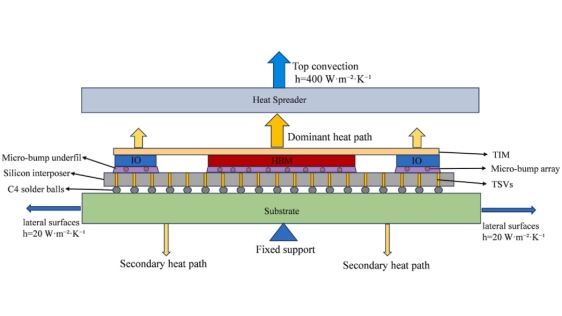
Simulations show that heat removal is dominated by the upward cooling path, creating a vertical temperature gradient and pronounced thermo-mechanical sensitivity in peripheral C4 solder joints. Under cycling, the joints approach a near-stabilized later-cycle response in which the equivalent plastic strain range Δεp and the inelastic strain-energy density increment ΔWave serve as comparative local fatigue-driving quantities. Applying the strain-based Engelmaier and energy-based Darveaux relations to the same later-cycle fields indicates that the outermost package-edge joint remains the dominant damage-sensitive location. In the transient fatigue analysis, introducing a viscoelastic underfill around the C4 solder balls reduces Δεp and ΔWave at these joints to about 5–10% of their no-underfill values, leading to markedly higher comparative fatigue-life estimates under the present modeling assumptions.
To read the full article, click here
Related Chiplet
- Optical Chiplet
- Reverse Gearbox Chiplet
- FlexGen Multi-Die Smart Network-on-Chip (NoC) IP
- Ncore Multi-Die Interconnect IP
- Integrated voltage regulator (IVR) chiplet
Related Technical Papers
- Thermo-mechanical co-design of 2.5D flip-chip packages with silicon and glass interposers via finite element analysis and machine learning
- Energy-/Carbon-Aware Evaluation and Optimization of 3-D IC Architecture With Digital Compute-in-Memory Designs
- FAPlace: Joint Optimization of Chiplet Placement and Interposer Footprint for 2.5D Systems
- CHICO-Agent: An LLM Agent for the Cross-layer Optimization of 2.5D and 3D Chiplet-based Systems
Latest Technical Papers
- Adaptive 3D Chiplet Architecture with Hybrid Wired–Wireless Interconnect for Energy-Efficient Heterogeneous Computing
- LLM-Augmented Bayesian Optimization with Adaptive Policies for Chiplet Design Space Exploration
- Divide and conquer: Scalable performance and energy in MCM GPUs
- A Composable AI-Accelerated Iterative Solver for 3D-IC Thermal Modeling
- QBX: A Compiler for 2-local Qubit Hamiltonian Simulation on Quantum Chiplets