Thermo-mechanical co-design of 2.5D flip-chip packages with silicon and glass interposers via finite element analysis and machine learning
By Mohammad Rafiee a, Farough Agin b , Kuldeep Kumar c , Ezhilan Murali c
a Department of Mechanical Engineering, University of Ottawa, Canada
b Department of Chemical and Biological Engineering, University of Ottawa, Canada
c School of Electrical Engineering and Computer Science, University of Ottawa, Canada
Abstract
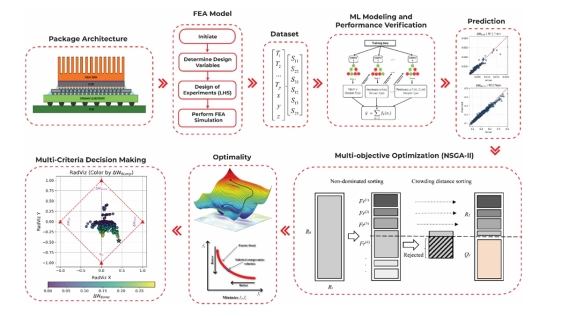
Advanced 2.5D flip-chip packages with silicon/glass interposers may pose tightly coupled thermo-mechanical trade-offs. This work presents a simulation-driven, machine-learning-assisted co-design framework that links high-fidelity finite-element analysis (FEA) with surrogate modeling, multi-objective optimization, and decision analysis. A 3D FEA model generates 500 Latin Hypercube design points for type of analysis (thermal and reliability), spanning geometry, materials, and thermal-path variables. Four minimized objectives are considered: junction-to-ambient thermal resistance (ΘJA) and cycle-averaged plastic strain-energy density at the corner flip- chip cu-pillar bump (ΔWbump), C4 bump (ΔWC4 ), and BGA (ΔWBGA ). Tree-based regressors (Random Forest, XGBoost) achieve high test-set fidelity and drive NSGA-II to enumerate the Pareto domain. A Net Flow multi-criteria decision method (MCDM) ranks Pareto candidates to identify a champion design with balanced thermo-mechanical performance. Re-simulation of the champion in FEA confirms surrogate accuracy for dominant responses (≈4–5 % deviation for ΔWbump and ΔWC4) and exact agreement for ΘJA , while revealing weak coupling between thermal and mechanical objectives—enabling partial decoupling of heat-path optimization from interconnect reliability.
To read the full article, click here
Related Chiplet
- Optical Chiplet
- Reverse Gearbox Chiplet
- FlexGen Multi-Die Smart Network-on-Chip (NoC) IP
- Ncore Multi-Die Interconnect IP
- Integrated voltage regulator (IVR) chiplet
Related Technical Papers
- Thermo-mechanical reliability evaluation and comparative fatigue assessment of 2.5D chiplet packages with viscoelastic C4 underfill
- Wafer Warpage of Silicon Interposer in Manufacturing Processes for High Density 2.5D Advanced Packaging: Causes, Measurement, Analysis and Optimization
- Advanced semiconductor packaging design via artificial intelligence and machine learning: A review
- Business Analysis of Chiplet-Based Systems and Technology
Latest Technical Papers
- Adaptive 3D Chiplet Architecture with Hybrid Wired–Wireless Interconnect for Energy-Efficient Heterogeneous Computing
- LLM-Augmented Bayesian Optimization with Adaptive Policies for Chiplet Design Space Exploration
- Divide and conquer: Scalable performance and energy in MCM GPUs
- A Composable AI-Accelerated Iterative Solver for 3D-IC Thermal Modeling
- QBX: A Compiler for 2-local Qubit Hamiltonian Simulation on Quantum Chiplets