HCRMap: Pressure-Aware Hot-Expert Residency Mapping for 3.5D MoE Chiplet Inference
By Yongqin Zhang
Nanjing Vocational College of Information Technology, Xianlin College Community, P.R.C.
Abstract
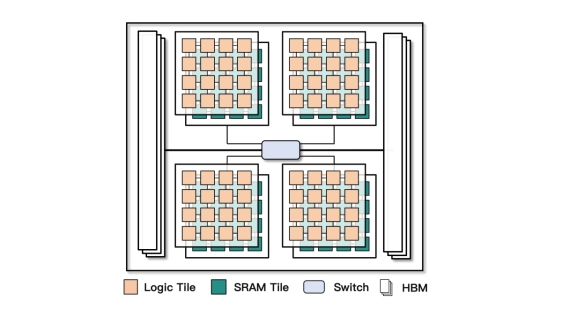
Mixture-of-Experts (MoE) large language models (LLM) activate only a small number of experts during inference, but token routing introduces persistent expert hotness skew: a small set of hot experts continuously receives most tokens, while the remaining experts are lightly loaded. On 3.5D multi-chiplet systems, this skew not only causes compute imbalance but also amplifies pressure on communication, memory bandwidth, I/O, and execution queues. Therefore, the core problem is not simply to reduce token movement, but to dynamically place and reuse hot expert replicas across different memory tiers.
This paper proposes HCRMap, a hot expert residency mapping framework for pressure-aware expert replica management in 3.5D MoE inference. Based on expert hotness, weight loading cost, migration overhead, and runtime resource pressure, HCRMap dynamically determines which experts should be promoted, retained, demoted, or evicted. It then maps routed token groups to suitable resident replicas, thereby jointly mitigating communication, memory, and queue bottlenecks.
Experimental results show that HCRMap reduces end-to-end latency by 43.6% and 43.0% over Hydra in the prefill and decode stages, respectively; by 34.5% and 33.1% over MoEntwine; and by 46.7% and 46.0% over PIMoE.
To read the full article, click here
Related Chiplet
- Optical Chiplet
- Reverse Gearbox Chiplet
- FlexGen Multi-Die Smart Network-on-Chip (NoC) IP
- Ncore Multi-Die Interconnect IP
- Integrated voltage regulator (IVR) chiplet
Related Technical Papers
- Compass: Mapping Space Exploration for Multi-Chiplet Accelerators Targeting LLM Inference Serving Workloads
- Mozart: Modularized and Efficient MoE Training on 3.5D Wafer-Scale Chiplet Architectures
- Mapping Space Exploration for Multi-Chiplet Accelerators Targeting LLM Inference Serving Workloads
- APEX: an Adaptive Photonic-Electronic Chiplet Interconnection Architecture for DNN Inference
Latest Technical Papers
- Adaptive 3D Chiplet Architecture with Hybrid Wired–Wireless Interconnect for Energy-Efficient Heterogeneous Computing
- LLM-Augmented Bayesian Optimization with Adaptive Policies for Chiplet Design Space Exploration
- Divide and conquer: Scalable performance and energy in MCM GPUs
- A Composable AI-Accelerated Iterative Solver for 3D-IC Thermal Modeling
- QBX: A Compiler for 2-local Qubit Hamiltonian Simulation on Quantum Chiplets