StreamDQ: Near-Memory Weight DeQuantization in Custom HBM for Scalable AI Inference Acceleration
By Minki Jeong, Daegun Yoon, Soohong Ahn, Seungyong Lee, Nameun Kang, Hyeonseok Ju, Ieryung Park, Joonseop Sim, Youngpyo Joo, Hoshik Kim
SK Hynix, Icheon, South Korea
Abstract
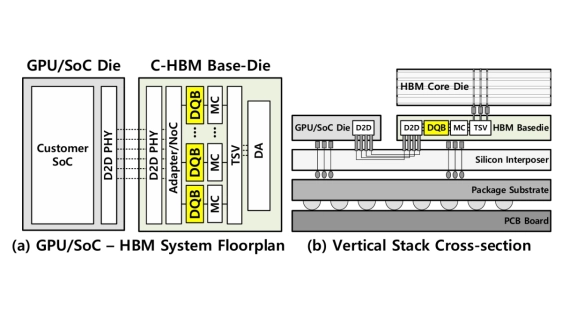
As large language models (LLMs) scale, their memory and computation demands have grown substantially, making weight-only quantization a widely adopted technique for reducing model size with minimal accuracy loss. However, on current GPUs, CUDA-core-based dequantization introduces substantial instruction overhead, on-chip traffic, and pipeline stalls, making it a major bottleneck for high-throughput, cloud-scale LLM serving. To address these limitations, we propose StreamDQ, a lightweight architectural enhancement that enables on-the-fly dequantization in the memory subsystem for high-throughput, large-batch LLM inference. StreamDQ integrates compact DeQuantization Blocks (DQBs) into the base die of high-bandwidth memory (HBM) and performs inline dequantization on standard memory loads. A lightweight sideband tag on each memory read request selects the dequantization mode while preserving conventional load semantics. By relocating dequantization to the memory side, StreamDQ eliminates GPU-side CUDA-core-based dequantization, thereby reducing on-chip traffic on the GPU and avoiding extra HBM write-back and reload of dequantized weights at large batch sizes. Our evaluation shows that StreamDQ achieves up to 7.08× speedup and 90.23% lower energy for mixed-precision GEMM, with only 0.127,mm2 area and 0.355 W power overhead per DQB in a 12 nm CMOS process. For end-to-end LLM inference, StreamDQ reduces latency by up to 54.68% and improves decode throughput by up to 2.20x.
To read the full article, click here
Related Chiplet
- Optical Chiplet
- Reverse Gearbox Chiplet
- FlexGen Multi-Die Smart Network-on-Chip (NoC) IP
- Ncore Multi-Die Interconnect IP
- Integrated voltage regulator (IVR) chiplet
Related Technical Papers
- PICNIC: Silicon Photonic Interconnected Chiplets with Computational Network and In-memory Computing for LLM Inference Acceleration
- DeepStack: Scalable and Accurate Design Space Exploration for Distributed 3D-Stacked AI Accelerators
- Exploring the Efficiency of 3D-Stacked AI Chip Architecture for LLM Inference with Voxel
- Formal Foundations for Known Good Reliable Die Screening in Chiplet-Based AI Systems-on-Chip
Latest Technical Papers
- Adaptive 3D Chiplet Architecture with Hybrid Wired–Wireless Interconnect for Energy-Efficient Heterogeneous Computing
- LLM-Augmented Bayesian Optimization with Adaptive Policies for Chiplet Design Space Exploration
- Divide and conquer: Scalable performance and energy in MCM GPUs
- A Composable AI-Accelerated Iterative Solver for 3D-IC Thermal Modeling
- QBX: A Compiler for 2-local Qubit Hamiltonian Simulation on Quantum Chiplets