The Power of Indirection: Scaling Switches Beyond Silicon Boundaries
By Lukas Röllin 1, Sushovan Das 1, Paolo Costa 2, Laurent Vanbever 1
1 ETH Zürich
2 Microsoft Research
Abstract
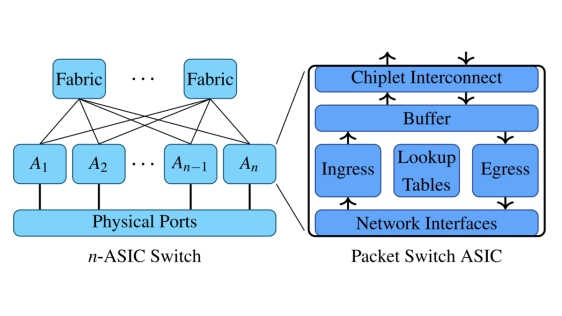
The slowdown of Moore's law and the area limit of monolithic integration have made chiplet-based designs inevitable across many domains, including network ASICs. However, combining multiple network ASICs together poses a fundamental challenge: maintaining sufficient inter-ASIC bandwidth to match the performance of an idealistic single-ASIC design. Providing full bandwidth is prohibitively expensive as it requires valuable forwarding capacity, while reducing inter-ASIC bandwidth creates severe performance bottlenecks.
We propose a novel multi-ASIC switch architecture that introduces a circuit-switched indirection layer in front of the ASICs. This layer flexibly remaps ingress ports across ASICs, localizing traffic and minimizing inter-ASIC communication based on observed patterns. Our system, Fastroute, combines packet and circuit switching to deliver performance comparable to a single-ASIC switch while reducing inter-ASIC bandwidth requirements. This frees up capacity for external network interfaces, allowing Fastroute to outperform traditional non-oversubscribed multi-ASIC designs. Our hardware prototype demonstrates the system's functional feasibility by evaluating it on an LLM training workload.
By reducing bandwidth and power overhead, Fastroute bridges the gap between silicon fabrication limits and soaring application demands. It provides an efficient transition to multi-ASIC switches, enabling bandwidth and radix demand to be met without waiting for the next ASIC generation.
To read the full article, click here
Related Chiplet
- Optical Chiplet
- Reverse Gearbox Chiplet
- FlexGen Multi-Die Smart Network-on-Chip (NoC) IP
- Ncore Multi-Die Interconnect IP
- Integrated voltage regulator (IVR) chiplet
Related Technical Papers
- The Evolution of Photonic Integrated Circuits and Silicon Photonics
- A Unified Interconnection Network for Chiplet-Based Scaling of the BrainScaleS Neuromorphic System
- Thermal Implications of Non-Uniform Power in BSPDN-Enabled 2.5D/3D Chiplet-based Systems-in-Package using Nanosheet Technology
- Thermo-mechanical co-design of 2.5D flip-chip packages with silicon and glass interposers via finite element analysis and machine learning
Latest Technical Papers
- Adaptive 3D Chiplet Architecture with Hybrid Wired–Wireless Interconnect for Energy-Efficient Heterogeneous Computing
- LLM-Augmented Bayesian Optimization with Adaptive Policies for Chiplet Design Space Exploration
- Divide and conquer: Scalable performance and energy in MCM GPUs
- A Composable AI-Accelerated Iterative Solver for 3D-IC Thermal Modeling
- QBX: A Compiler for 2-local Qubit Hamiltonian Simulation on Quantum Chiplets