Tri-Stack-PIM: A Heterogeneous Multi-Die 3D-Integrated Processing-in-Memory Architecture for Efficient LLM Inference
By Shuao Jia, Zichao Ling, Chen Bai, Kang Zhao, Jianwang Zhai
Beijing University of Posts and Telecommunications, Beijing, China
Abstract
Large language model (LLM) inference during autoregressive decoding is fundamentally memory-bandwidth-bound. Existing three-dimensional (3D) stacked processing-in-memory (PIM) architectures alleviate the off-chip bandwidth wall, yet remain constrained by several limitations: physical layer (PHY), controllers, and direct memory access (DMA) engines compete with arithmetic units for advanced-node base-die area; hybrid-bonding keep-out zones fragment the base-die floorplan and impede physical design; compute tiles built in a dynamic random access memory (DRAM) process are restricted to low logic density, capping achievable throughput; and nonlinear operations offloaded to the host reintroduce a communication bottleneck.
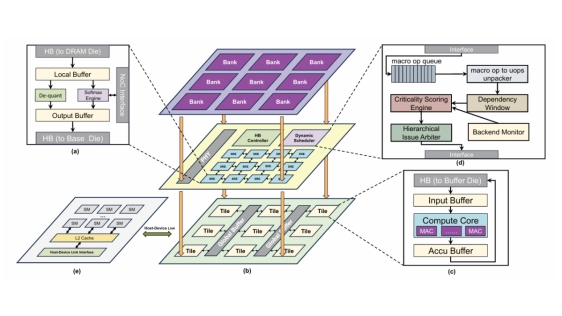
We present Tri-Stack-PIM, a heterogeneous three-die architecture that resolves these tensions by dedicating a top DRAM die to storage, a middle buffer die on a mature process node to PHYs, DMA engines, and near-memory compute units, and a bottom base die on an advanced node exclusively to single-instruction-multiple-data (SIMD) multiply-accumulate (MAC) arrays. We further introduce a Unified Buffer-Aware Ready-based (UBAR) hardware out-of-order micro-operation scheduler that enforces cross-die dependency correctness at runtime while maximizing issue-slot utilization through a multi-term priority function, recovering up to 90% of the cycles that an in-order policy would forfeit. A joint architecture-dataflow co-exploration identifies Pareto-optimal configurations that reduce the energy-delay product (EDP) by 33-66x over naive parameter selection. Evaluated across multi-head, grouped-query, and multi-query attention (MHA, GQA, MQA) mechanisms with batch sizes 1-32, Tri-Stack-PIM achieves geometric-mean speedups of 4.95x, 2.57x, and 1.68x across all three attention mechanisms and batch sizes over a graphics processing unit (GPU) baseline, AttAcc, and H2-LLM, respectively.
CCS Concepts
• Hardware →3Dintegrated circuits.
Keywords
3D Integration, System-Technology Co-Optimization
To read the full article, click here
Related Chiplet
- Optical Chiplet
- Reverse Gearbox Chiplet
- FlexGen Multi-Die Smart Network-on-Chip (NoC) IP
- Ncore Multi-Die Interconnect IP
- Integrated voltage regulator (IVR) chiplet
Related Technical Papers
- Exploring the Efficiency of 3D-Stacked AI Chip Architecture for LLM Inference with Voxel
- Chiplet-NAS: Chiplet-aware Neural Architecture Search for Efficient AI Inference on 2.5D Integration
- Cambricon-LLM: A Chiplet-Based Hybrid Architecture for On-Device Inference of 70B LLM
- Hemlet: A Heterogeneous Compute-in-Memory Chiplet Architecture for Vision Transformers with Group-Level Parallelism
Latest Technical Papers
- Tri-Stack-PIM: A Heterogeneous Multi-Die 3D-Integrated Processing-in-Memory Architecture for Efficient LLM Inference
- CU-3D: A Scalable Legality-Aware RTL-to-GDS Flow for 3D-IC Physical Design
- Beyond Host-Side Control: HBM Controller Partitioning Across Host and HBM Base Dies
- Chiplet-NAS: Chiplet-aware Neural Architecture Search for Efficient AI Inference on 2.5D Integration
- Scaling Up Analog CIM: A Simulation Framework for Topology-Aware Mapping