CU-3D: A Scalable Legality-Aware RTL-to-GDS Flow for 3D-IC Physical Design
By Mingjun Wang 1, Guanqi Li 2,5, Yihan Wen 1, Lancheng Zou 1, Mingjun Li 1, Feng Gu 1, Fengrui Liu 2,5, Jianan Mu 2, Yuxuan Zhao 3, Tsung-Yi Ho 1, Huawei Li 2,5, Sung Kyu Lim 4, Bei Yu 1
1 The Chinese University of Hong Kong
2 Institute of Computing Technology, Chinese Academy of Sciences, Beijing, China
3 The Chinese University of Hong Kong, Shenzhen
4 University of Southern California
5 University of Chinese Academy of Sciences, Beijing, China
Abstract
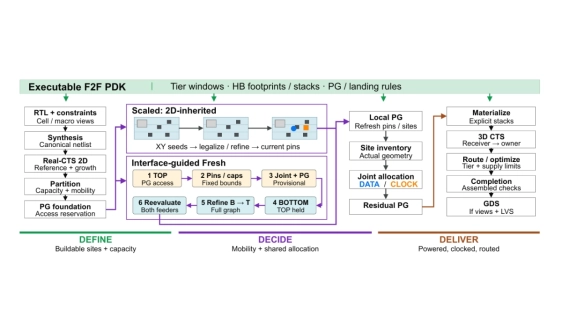
Face-to-face (F2F) hybrid bonds shorten interdie connections, but data, clock, and power-grid (PG) connections must be realized together. CU-3D is a RTL-to-GDS physical design flow based on commercial EDA tools. It derives role-compatible hybrid-bond (HB) sites from a 17-metal ASAP7-based technology model, complete HB footprints, and constructed PG geometry. To coordinate partitioning with placement flexibility, Scaled refines an inherited 2D placement, whereas Fresh places the receiving die first and uses its pin locations and clock loads to guide placement of the other die. Data and clock HB assignments are jointly optimized while retaining alternative data sites and reserving capacity for subsequent PG assignment. The selected HB sites and stacks are preserved during 3D clock-tree synthesis, supply-aware cell insertion, and routing. Across eleven designs, including a 133-macro processor, the flow achieves zero backend DRC violations and passes signal-connectivity checks. Nine paired designs admit lower-footprint, lower-power implementations; four improve setup WNS. On JPEG, early joint planning gains 87 ps and mobility-aware partitioning gains 346 ps. Path analysis explains why cell-delay savings can outweigh net-delay increases.
To read the full article, click here
Related Chiplet
- Optical Chiplet
- Reverse Gearbox Chiplet
- FlexGen Multi-Die Smart Network-on-Chip (NoC) IP
- Ncore Multi-Die Interconnect IP
- Integrated voltage regulator (IVR) chiplet
Related Technical Papers
- DeepOHeat-v1: Efficient Operator Learning for Fast and Trustworthy Thermal Simulation and Optimization in 3D-IC Design
- Network Design for Wafer-Scale Systems with Wafer-on-Wafer Hybrid Bonding
- Escaping Flatland: A Placement Flow for Enabling 3D FPGAs
- DeepStack: Scalable and Accurate Design Space Exploration for Distributed 3D-Stacked AI Accelerators
Latest Technical Papers
- Tri-Stack-PIM: A Heterogeneous Multi-Die 3D-Integrated Processing-in-Memory Architecture for Efficient LLM Inference
- CU-3D: A Scalable Legality-Aware RTL-to-GDS Flow for 3D-IC Physical Design
- Beyond Host-Side Control: HBM Controller Partitioning Across Host and HBM Base Dies
- Chiplet-NAS: Chiplet-aware Neural Architecture Search for Efficient AI Inference on 2.5D Integration
- Scaling Up Analog CIM: A Simulation Framework for Topology-Aware Mapping