A Unified Interconnection Network for Chiplet-Based Scaling of the BrainScaleS Neuromorphic System
By Robin Heinemann, Johannes Schemmel
Institute of Computer Engineering, Heidelberg University, Heidelberg, Germany
Abstract
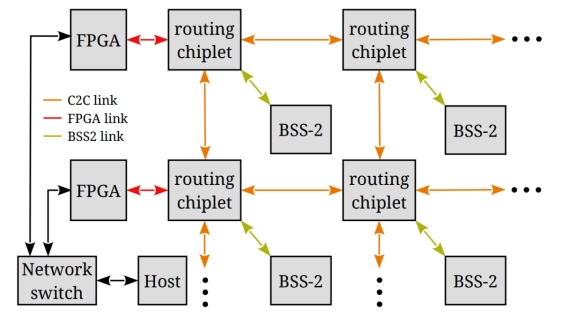
The BrainScaleS-2 (BSS-2) neuromorphic architecture combines analog emulation of spiking neural network (SNN) primitives with tightly coupled ADCs and digital processing units. These analog SNN primitives are fixed hardware resources that cannot be multiplexed, limiting the emulated network size to the number of physical hardware copies. To overcome the challenges of scaling analog designs, chiplet-based designs offer a promising approach with cost and flexibility advantages over monolithic scaling. Implementing a chiplet-based BSS-2 architecture requires an interconnection network that handles two distinct classes of traffic: error-tolerant traffic such as spikes and error-intolerant traffic like configuration data or data exchanged by the processing units. This work presents the design of a routing chiplet for the BSS-2 architecture that enables interconnection of multiple BSS-2 units in a 2D mesh topology. Both traffic classes are multiplexed over a single wide parallel die-to-die link. Exploiting the fault tolerance of SNNs, spikes are transmitted unsecured and synchronously, with the arrival time on the receiving side directly determining the pre-synaptic time of the spike. Conversely, error-intolerant data transmission is secured by a point-to-point Automatic Repeat Request protocol and uses credit-based flow control. These design choices are validated in simulation, where the proposed design can sustain 95% link bandwidth utilization for the use case of surrogate gradient training across a wide range of spike-to-secured traffic ratios under a 1×10−10 bit error rate with little impact on spike timing jitter.
To read the full article, click here
Related Chiplet
- Optical Chiplet
- Reverse Gearbox Chiplet
- FlexGen Multi-Die Smart Network-on-Chip (NoC) IP
- Ncore Multi-Die Interconnect IP
- Integrated voltage regulator (IVR) chiplet
Related Technical Papers
- DISTIL: A Distributed Spiking Neural Network Accelerator on 2.5D Chiplet Systems
- Photonic Chiplet Interconnection via 3D-Nanoprinted Interposer
- Inter-chip Clock Network Synthesis on Passive Interposer of 2.5D Chiplet Considering Transmission Line Effect
- APEX: an Adaptive Photonic-Electronic Chiplet Interconnection Architecture for DNN Inference
Latest Technical Papers
- Embodied Emissions of 2.5D and 3D Scaling in Chipletized GPUs for Low-Carbon AI
- Adaptive 3D Chiplet Architecture with Hybrid Wired–Wireless Interconnect for Energy-Efficient Heterogeneous Computing
- LLM-Augmented Bayesian Optimization with Adaptive Policies for Chiplet Design Space Exploration
- Divide and conquer: Scalable performance and energy in MCM GPUs
- A Composable AI-Accelerated Iterative Solver for 3D-IC Thermal Modeling