Starscream: Reimagining LLM Sharding on AMD Instinct GPUs with GPU Partitioning
By Sumanth Gudaparthi, Smeet Chheda, Ganesh Dasika
AMD Research and Advanced Development
Abstract
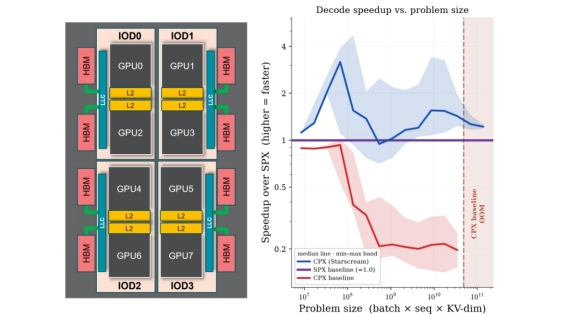
As GPU accelerators grow larger to meet rising compute demands, they exhibit increasingly pronounced non-uniform memory access (NUMA) characteristics that challenge existing LLM frameworks. Chiplet-based architectures provide a practical path to larger GPUs while mitigating manufacturing yield constraints. Modern GPUs such as AMD Instinct MI300X employs such a multi-die design, and further offer GPU partitioning capabilities, partitioning a single physical GPU into multiple logical devices with NUMA-aware memory domains, promising faster kernel launches, and reduced memory access latencies with improved locality. However, current parallelization strategies, designed for homogeneous GPU topologies, when applied under partitioning, extend its unidimensional sharding causing significant performance degradation. Three bottlenecks emerge: (1) memory redundancy; (2) arithmetic intensity collapse; (3) communication overhead from flat collectives. We present Starscream, a rethinking of LLM sharding for the chiplet era. Rather than stretching inter-GPU sharding thinner, Starscream adds intra-GPU sharding along an orthogonal dimension, grounded in three foundational principles: kernel shape preservation, memory redundancy elimination, and communication overhead minimization. These principles form the basis for extending any sharding strategy into the partitioning regime. We demonstrate their effectiveness using tensor parallelism as a case study. On AMD MI300X and MI355X, exploiting partitioning capabilities yields up to 4x speedup for attention and 1.43x for fused GEMMs compared to chiplet-oblivious baselines, demonstrating the effectiveness of chiplet-aware designs. Starscream's principles generalize across sharding strategies and future architectures.
To read the full article, click here
Related Chiplet
- Optical Chiplet
- Reverse Gearbox Chiplet
- FlexGen Multi-Die Smart Network-on-Chip (NoC) IP
- Ncore Multi-Die Interconnect IP
- Integrated voltage regulator (IVR) chiplet
Related Technical Papers
- TA3D: Timing-Aware 3D IC Partitioning and Placement by Optimizing the Critical Path
- Cambricon-LLM: A Chiplet-Based Hybrid Architecture for On-Device Inference of 70B LLM
- ChipletPart: Scalable Cost-Aware Partitioning for 2.5D Systems
- HALO: Memory-Centric Heterogeneous Accelerator with 2.5D Integration for Low-Batch LLM Inference
Latest Technical Papers
- Starscream: Reimagining LLM Sharding on AMD Instinct GPUs with GPU Partitioning
- Tri-Stack-PIM: A Heterogeneous Multi-Die 3D-Integrated Processing-in-Memory Architecture for Efficient LLM Inference
- CU-3D: A Scalable Legality-Aware RTL-to-GDS Flow for 3D-IC Physical Design
- Beyond Host-Side Control: HBM Controller Partitioning Across Host and HBM Base Dies
- Chiplet-NAS: Chiplet-aware Neural Architecture Search for Efficient AI Inference on 2.5D Integration