Quantum Dot DBR Lasers Monolithically Integrated on Silicon Photonics by In-Pocket Heteroepitaxy
By Rosalyn Koscica 1, Alec Skipper 1, Bei Shi 1, Kaiyin Feng 1, Gerald Leake 2 and Michael Zylstra 3
1 University of California, USA
2 RF SUNY Polytechnic Institute, USA
3 Analog Photonics, USA
Abstract:
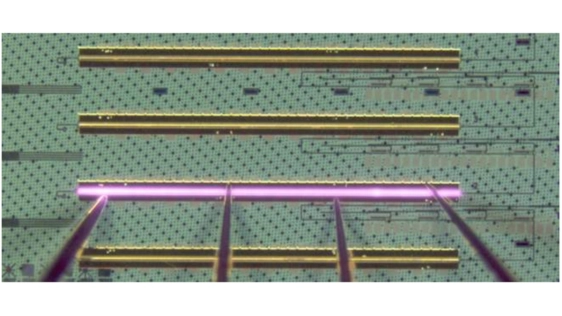
Monolithically integrated lasers on silicon photonics enable scalable, foundry-compatible production for data communications applications. However, material mismatches in heteroepitaxial systems and high coupling losses pose challenges for III-V integration on silicon. We combine three techniques: recessed silicon pockets for III-V growth, two-step heteroepitaxy using both MOCVD and MBE, and a polymer facet gap-fill approach to develop O-band InAs quantum dot lasers monolithically integrated on silicon photonics chiplets. Lasers coupled to silicon ring resonators and silicon nitride distributed Bragg reflectors (DBR) demonstrate single-mode lasing with side-mode suppression ratio up to 32 dB. Devices lase at temperatures up to 105 °C with an extrapolated operational lifetime of 6.2 years at 35 °C.
Index Terms—Active-passive coupling, DBR laser, III-V on Si integration, monolithic integration, optical coupling, O-band, quantum dot laser, semiconductor laser, silicon photonics.
To read the full article, click here
Related Chiplet
- Optical Chiplet
- Reverse Gearbox Chiplet
- FlexGen Multi-Die Smart Network-on-Chip (NoC) IP
- Ncore Multi-Die Interconnect IP
- Integrated voltage regulator (IVR) chiplet
Related Technical Papers
- Micro-Transfer Printing on Silicon Photonics: Tutorial, Recent Progress and Outlook
- The Evolution of Photonic Integrated Circuits and Silicon Photonics
- To Scale Up or To Scale Out: Evaluating Space-Time Costs of Compiled Logical Circuits on Modular Superconducting Quantum Processors
- QBX: A Compiler for 2-local Qubit Hamiltonian Simulation on Quantum Chiplets
Latest Technical Papers
- Adaptive 3D Chiplet Architecture with Hybrid Wired–Wireless Interconnect for Energy-Efficient Heterogeneous Computing
- LLM-Augmented Bayesian Optimization with Adaptive Policies for Chiplet Design Space Exploration
- Divide and conquer: Scalable performance and energy in MCM GPUs
- A Composable AI-Accelerated Iterative Solver for 3D-IC Thermal Modeling
- QBX: A Compiler for 2-local Qubit Hamiltonian Simulation on Quantum Chiplets