Network Design for Wafer-Scale Systems with Wafer-on-Wafer Hybrid Bonding
By Patrick Iff, Tommaso Bonato, Maciej Besta, Luca Benini, Torsten Hoefler
ETH Zurich
Abstract
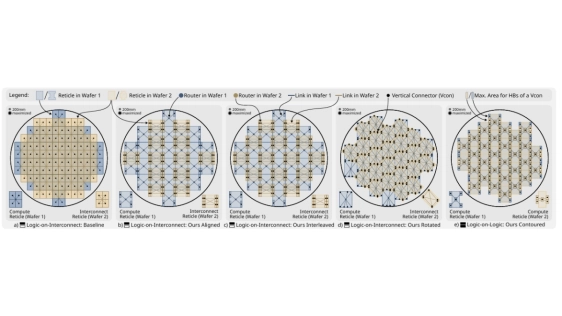
Transformer-based large language models are increasingly constrained by data movement as communication bandwidth drops sharply beyond the chip boundary. Wafer-scale integration using wafer-on-wafer hybrid bonding alleviates this limitation by providing ultra-high bandwidth between reticles on bonded wafers. In this paper, we investigate how the physical placement of reticles on wafers influences the achievable network topology and the resulting communication performance. Starting from a 2D mesh-like baseline, we propose four reticle placements (Aligned, Interleaved, Rotated, and Contoured) that improve throughput by up to 250%, reduce latency by up to 36%, and decrease energy per transmitted byte by up to 38%.
To read the full article, click here
Related Chiplet
- Optical Chiplet
- Reverse Gearbox Chiplet
- FlexGen Multi-Die Smart Network-on-Chip (NoC) IP
- Ncore Multi-Die Interconnect IP
- Integrated voltage regulator (IVR) chiplet
Related Technical Papers
- Revamping the Semiconductor Industry with Hybrid Bonding
- Hybrid Bonding With Polymeric Interlayer Dielectric Layers Patterned by Nanoimprint Lithography
- PICNIC: Silicon Photonic Interconnected Chiplets with Computational Network and In-memory Computing for LLM Inference Acceleration
- Probing the Nanoscale Onset of Plasticity in Electroplated Copper for Hybrid Bonding Structures via Multimodal Atomic Force Microscopy
Latest Technical Papers
- Embodied Emissions of 2.5D and 3D Scaling in Chipletized GPUs for Low-Carbon AI
- Adaptive 3D Chiplet Architecture with Hybrid Wired–Wireless Interconnect for Energy-Efficient Heterogeneous Computing
- LLM-Augmented Bayesian Optimization with Adaptive Policies for Chiplet Design Space Exploration
- Divide and conquer: Scalable performance and energy in MCM GPUs
- A Composable AI-Accelerated Iterative Solver for 3D-IC Thermal Modeling