CarbonPATH: Carbon-aware pathfinding and architecture optimization for chiplet-based AI systems
By Chetan Choppali Sudarshan, Jiajun Hu, Aman Arora, and Vidya A. Chhabria
Arizona State University
Abstract
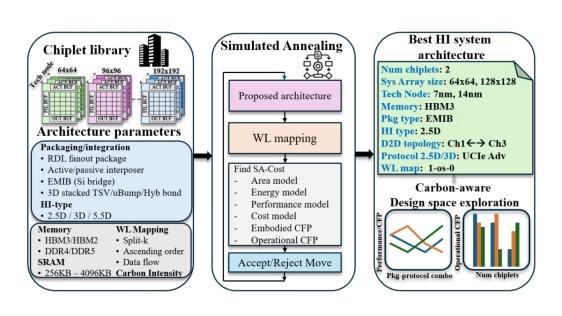
The exponential growth of AI has created unprecedented demand for computational resources, pushing chip designs to the limit while simultaneously escalating the environmental footprint of computing. As the industry transitions toward heterogeneous integration (HI) to address the yield and cost challenges of monolithic scaling, minimizing the carbon cost of these complex HI systems becomes critical. To fully exploit HI, a co-design approach spanning application, architecture, chip, and packaging is essential. However, this creates a vast design space with competing objectives, specifically the trade-offs between performance, cost, and carbon footprint (CFP) for sustainability. CarbonPATH is an early-stage pathfinding framework designed to address this multi-objective challenge. It identifies optimized HI systems by co-designing workload mapping, architectural parameters, and packaging technologies, while treating sustainability as a first-class design constraint. The framework accounts for a wide range of factors, including compute and memory sizes, chiplet technology nodes, communication protocols, integration style (2D, 2.5D, 3D), operational CFP, embodied CFP, and interconnect type. Using simulated annealing, CarbonPATH explores this high-dimensional space to identify solutions that balance traditional metrics against environmental impact. By capturing interactions across applications, architectures, chiplets, and packaging, CarbonPATH uncovers system-level solutions that traditional methods often miss due to restrictive assumptions or limited scope.
To read the full article, click here
Related Chiplet
- Optical Chiplet
- Reverse Gearbox Chiplet
- FlexGen Multi-Die Smart Network-on-Chip (NoC) IP
- Ncore Multi-Die Interconnect IP
- Integrated voltage regulator (IVR) chiplet
Related Technical Papers
- CHICO-Agent: An LLM Agent for the Cross-layer Optimization of 2.5D and 3D Chiplet-based Systems
- FAPlace: Joint Optimization of Chiplet Placement and Interposer Footprint for 2.5D Systems
- Optimization of Test-Access Architectures and Test Scheduling for 2.5D/3D Integration
- Formal Foundations for Known Good Reliable Die Screening in Chiplet-Based AI Systems-on-Chip
Latest Technical Papers
- Adaptive 3D Chiplet Architecture with Hybrid Wired–Wireless Interconnect for Energy-Efficient Heterogeneous Computing
- LLM-Augmented Bayesian Optimization with Adaptive Policies for Chiplet Design Space Exploration
- Divide and conquer: Scalable performance and energy in MCM GPUs
- A Composable AI-Accelerated Iterative Solver for 3D-IC Thermal Modeling
- QBX: A Compiler for 2-local Qubit Hamiltonian Simulation on Quantum Chiplets