Scaling Up Analog CIM: A Simulation Framework for Topology-Aware Mapping
By Yuxin Ren, Danella Zhao, Huanrui Yang
The University of Arizona, Tucson, USA
Abstract
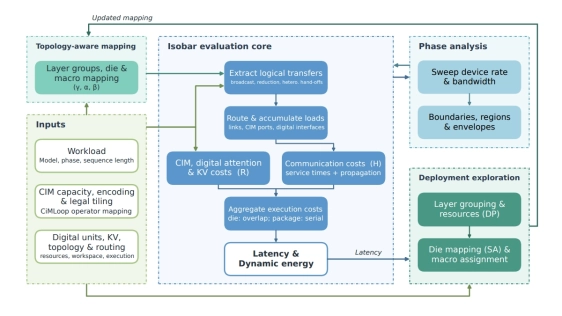
Analog compute-in-memory (CIM) enables energy-efficient AI inference by performing in-situ matrix multiplication. The growing demand for deploying larger models motivates chiplet integration to expand CIM capacity. However, simulation abstractions based on local operator costs and aggregate communication metrics obscure the impact of weight-mapping topology when CIM system scales up. We develop a phase analysis that quantifies how strongly mapping topology affects system performance across hardware configurations and how mapping optimization translates into latency gains. To evaluate and exploit this design space, we present Isobar, a simulation platform integrating CIM decompositions, heterogeneous execution, and resource modeling. Validated against silicon measurements and cycle-accurate simulation, Isobar provides reliable cost estimates that enable effective mapping search across model and hardware configurations. For Gemma-7B prefill, Isobar-guided mapping reduces communication time by 23.3% and end-to-end latency by 18.6% relative to the strongest baseline. Isobar's system-level modeling show that analog CIM retains energy-efficiency potential relative to GPU when scaled to thousands of dies, and identify topology-aware mapping as a key design dimension for efficient execution.
To read the full article, click here
Related Chiplet
- Optical Chiplet
- Reverse Gearbox Chiplet
- FlexGen Multi-Die Smart Network-on-Chip (NoC) IP
- Ncore Multi-Die Interconnect IP
- Integrated voltage regulator (IVR) chiplet
Related Technical Papers
- Muchisim: A Simulation Framework for Design Exploration of Multi-Chip Manycore Systems
- ATSim: A Fast and Accurate Simulation Framework for 2.5D/3D Chiplet Thermal Design Optimization
- LEGOSim: A Unified Parallel Simulation Framework for Multi-chiplet Heterogeneous Integration
- CHIPSIM: A Co-Simulation Framework for Deep Learning on Chiplet-Based Systems
Latest Technical Papers
- Scaling Up Analog CIM: A Simulation Framework for Topology-Aware Mapping
- AI-Based Image Enhancement Improves Detection of Interconnect Defects in Microelectronic Packaging
- Embodied Emissions of 2.5D and 3D Scaling in Chipletized GPUs for Low-Carbon AI
- Adaptive 3D Chiplet Architecture with Hybrid Wired–Wireless Interconnect for Energy-Efficient Heterogeneous Computing
- LLM-Augmented Bayesian Optimization with Adaptive Policies for Chiplet Design Space Exploration