Beyond Host-Side Control: HBM Controller Partitioning Across Host and HBM Base Dies
By Tharunya Yogananda, Wantong Li
University of California, Riverside
Abstract
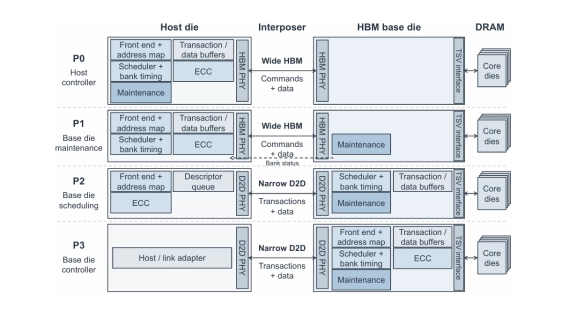
Recent generations of high bandwidth memory (HBM), such as HBM4, allow the base die of the memory stack to be manufactured using a logic process that can accommodate more complex controller functions next to the DRAM. We present the first systematic quantitative study of function-level controller placement between the host and the HBM4 base die on a silicon interposer. We divide the controller into its main functions and evaluate four placements, from a complete host controller to a complete base die controller, with intermediate placements that move maintenance or scheduling to the base die. We extend Ramulator 2 with HBM4 timing and maintenance, model a die-to-die (D2D) link with timing checks at the DRAM interface, and compose area, energy, and temperature from synthesized controller blocks, modeled storage, and interface data. A provisioned D2D link preserves per-stack bandwidth and adds about twice its one-way delay to unloaded latency. Maintenance moves to the base die with no bandwidth cost and frees host command slots, and the freed share grows with stack height. Replacing the wide interface with a D2D link saves 61% of host shoreline and 16.85 mm2 of host area per stack. The D2D link dominates the added base die area and power, and the base die runs cooler under streaming with link energy below 0.4 pJ/bit. Shared control delivers up to 1.72x the throughput of static partitioning between two requestors.
Index Terms — High bandwidth memory, memory controller, base die, die-to-die interface, 2.5D integration
To read the full article, click here
Related Chiplet
- Optical Chiplet
- Reverse Gearbox Chiplet
- FlexGen Multi-Die Smart Network-on-Chip (NoC) IP
- Ncore Multi-Die Interconnect IP
- Integrated voltage regulator (IVR) chiplet
Related Technical Papers
- 3D Stacked HBM and Compute Accelerators for LLM: Optimizing Thermal Management and Power Delivery Efficiency
- Small Dies, Big Dreams: Challenges and Opportunities in Chiplet Commoditization
- TA3D: Timing-Aware 3D IC Partitioning and Placement by Optimizing the Critical Path
- Speeding Down Memory Lane With Custom HBM
Latest Technical Papers
- Beyond Host-Side Control: HBM Controller Partitioning Across Host and HBM Base Dies
- Chiplet-NAS: Chiplet-aware Neural Architecture Search for Efficient AI Inference on 2.5D Integration
- Scaling Up Analog CIM: A Simulation Framework for Topology-Aware Mapping
- AI-Based Image Enhancement Improves Detection of Interconnect Defects in Microelectronic Packaging
- Embodied Emissions of 2.5D and 3D Scaling in Chipletized GPUs for Low-Carbon AI