ATSim: A Fast and Accurate Simulation Framework for 2.5D/3D Chiplet Thermal Design Optimization
By Qipan Wang 1,2, Tianxiang Zhu 1, Jiajia Cui 1, Yicheng Wei 1, Linxiao Shen 1, Zhe Cheng 1, Runsheng Wang 1,3,4, Ru Huang 1,3,4, Yibo Lin 1,3,4
1 School of Integrated Circuits, Peking University
2 Academy for Advanced Interdisciplinary Studies, Peking University
3 Institute of Electronic Design Automation, Peking University, Wuxi, China
4 Beijing Advanced Innovation Center for Integrated Circuits, Beijing, China
Abstract
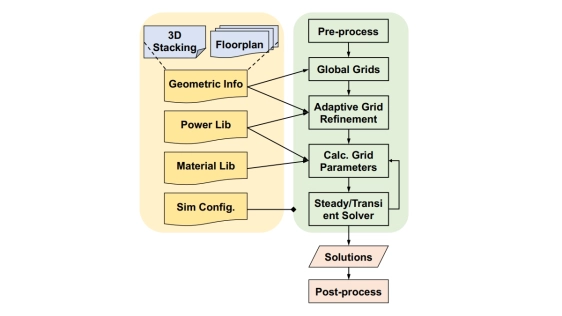
This paper reviews the thermal challenges in 2.5D/3D chiplet integration systems and introduces ATSim, a simulation framework with applications to chiplet thermal optimization. ATSim enables fast and accurate thermal simulation for both steady-state and transient conditions. It supports nonlinear, heterogeneous, and anisotropic materials. The framework features a multilevel grid generation scheme based on a novel hybrid tree structure. Compared to mainstream academic and commercial tools, ATSim achieves high accuracy and efficiency, making it a powerful tool for evaluating and improving thermal designs, including applications like thermal-aware placement.
To read the full article, click here
Related Chiplet
- Optical Chiplet
- Reverse Gearbox Chiplet
- FlexGen Multi-Die Smart Network-on-Chip (NoC) IP
- Ncore Multi-Die Interconnect IP
- Integrated voltage regulator (IVR) chiplet
Related Technical Papers
- DeepOHeat-v1: Efficient Operator Learning for Fast and Trustworthy Thermal Simulation and Optimization in 3D-IC Design
- 3D-ICE 4.0: Accurate and efficient thermal modeling for 2.5D/3D heterogeneous chiplet systems
- ThermoDSE: A Thermal-Aware and Comprehensive Design Space Exploration for Chiplet-Based DNN Accelerators
- CLIPGen: A Chiplet Link IP Modeling and Generation Framework for 2.5D Architecture Exploration
Latest Technical Papers
- LLM-Augmented Bayesian Optimization with Adaptive Policies for Chiplet Design Space Exploration
- Divide and conquer: Scalable performance and energy in MCM GPUs
- A Composable AI-Accelerated Iterative Solver for 3D-IC Thermal Modeling
- QBX: A Compiler for 2-local Qubit Hamiltonian Simulation on Quantum Chiplets
- U-Can-Inject-Errors (UCIe): A Protocol-Aware Hardware Trojan for FPGA Chiplet Links