ATMPlace: Analytical Thermo-Mechanical-Aware Placement Framework for 2.5D-IC
By Qipan Wang, Tianxiang Zhu, Tianyu Jia , Yibo Lin , Runsheng Wang , Ru Huang
Peking University, China
Abstract
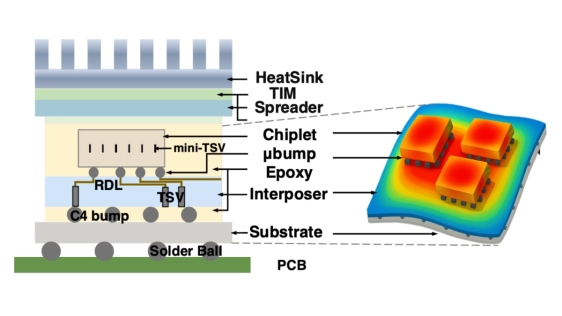
Rising demand in AI and automotive applications is accelerating 2.5D-IC adoption, with multiple chiplets tightly placed to enable high-speed interconnects and heterogeneous integration. As chiplet counts grow, traditional placement tools—limited by poor scalability and reliance on slow simulations—must evolve beyond wirelength minimization to address thermal and mechanical reliability, critical challenges in heterogeneous integration.
In this paper, we present ATMPlace, the first analytical placer for 2.5D-ICs that jointly optimizes wirelength, peak temperature, and operational warpage using physics-based compact models. It generates Pareto-optimal placements for systems with dozens of chiplets. Experimental results demonstrate superior performance: 146% and 52% geo-mean wirelength improvement over TAP-2.5D and TACPlace, respectively, with 3–13% lower temperature and 5–27% less warpage — all achieved ∼10× faster. The proposed framework is general and can be extended to enable fast, scalable, and reliable design exploration for next-generation 2.5D systems.
Index Terms — 2.5D-IC; Thermo-Mechanical Optimization; Chiplet Placement; Thermal Warpage
To read the full article, click here
Related Chiplet
- Optical Chiplet
- Reverse Gearbox Chiplet
- FlexGen Multi-Die Smart Network-on-Chip (NoC) IP
- Ncore Multi-Die Interconnect IP
- Integrated voltage regulator (IVR) chiplet
Related Technical Papers
- ATPlace2.5D: Analytical Thermal-Aware Chiplet Placement Framework for Large-Scale 2.5D-IC
- CHIPSIM: A Co-Simulation Framework for Deep Learning on Chiplet-Based Systems
- Scope: A Scalable Merged Pipeline Framework for Multi-Chip-Module NN Accelerators
- Escaping Flatland: A Placement Flow for Enabling 3D FPGAs
Latest Technical Papers
- Adaptive 3D Chiplet Architecture with Hybrid Wired–Wireless Interconnect for Energy-Efficient Heterogeneous Computing
- LLM-Augmented Bayesian Optimization with Adaptive Policies for Chiplet Design Space Exploration
- Divide and conquer: Scalable performance and energy in MCM GPUs
- A Composable AI-Accelerated Iterative Solver for 3D-IC Thermal Modeling
- QBX: A Compiler for 2-local Qubit Hamiltonian Simulation on Quantum Chiplets