2.5D Root of Trust: Securing the Chiplet Ecosystem
By Charles Williams 1, Mohammed Nabeel 2, Gino Chacon 3, Ozgur Sinanoglu 4, Paul V. Gratz 1, Johann Knechtel 4
1 Texas A&M University
2 New York University
3 AheadComputing
4 New York University Abu Dhabi
Abstract
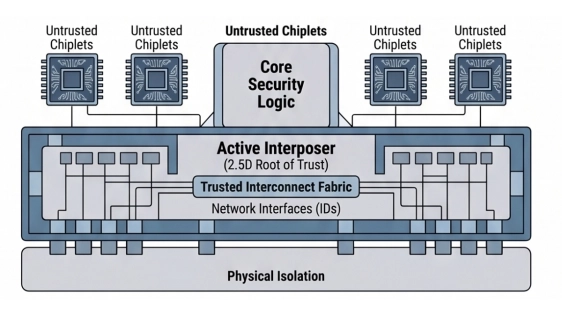
The semiconductor industry is rapidly transitioning from monolithic systems-on-chip toward heterogeneous, multi-vendor 2.5D chiplet ecosystems integrated via silicon interposers. While this paradigm shift offers immense benefits in yield, cost, and time-to-market, it radically expands the attack surface. Integrating chiplets from untrusted foundries and design houses introduces vulnerabilities to hardware Trojans, IP piracy, and system-level communication exploits. Critically, chip-level security features and conventional Root of Trust (RoT) proposals are insufficient in this context: any component, including the interconnect fabric itself, may be sourced from an untrusted vendor. This perspective paper surveys state-of-the-art security strategies for interposer-based 2.5D integration, focusing on three threat categories: interconnect attacks (snooping, spoofing, and man-in-the-middle), cache coherence exploits including complex forging attacks, and microarchitectural side-channel threats. We examine design-time defenses via 2.5D split manufacturing and, more crucially, runtime defenses that establish an active interposer as a physically isolated 2.5D RoT. By embedding so-called transaction monitors and coherence message checkers within the trusted interposer fabric, the system enforces memory access permissions by construction and neutralizes coherence-level attacks without need for modifying/securing the commodity chiplets. Finally, we review the EDA flows required to realize these defenses and show they concurrently improve power and signal integrity while reducing overall system footprint.
To read the full article, click here
Related Chiplet
- Optical Chiplet
- Reverse Gearbox Chiplet
- FlexGen Multi-Die Smart Network-on-Chip (NoC) IP
- Ncore Multi-Die Interconnect IP
- Integrated voltage regulator (IVR) chiplet
Related Technical Papers
- Securing the new chiplet era of semiconductor design
- CHICO-Agent: An LLM Agent for the Cross-layer Optimization of 2.5D and 3D Chiplet-based Systems
- Thermo-mechanical reliability evaluation and comparative fatigue assessment of 2.5D chiplet packages with viscoelastic C4 underfill
- Stop-For-Top IP model to replace One-Stop-Shop by 2025... and support the creation of successful Chiplet business
Latest Technical Papers
- Adaptive 3D Chiplet Architecture with Hybrid Wired–Wireless Interconnect for Energy-Efficient Heterogeneous Computing
- LLM-Augmented Bayesian Optimization with Adaptive Policies for Chiplet Design Space Exploration
- Divide and conquer: Scalable performance and energy in MCM GPUs
- A Composable AI-Accelerated Iterative Solver for 3D-IC Thermal Modeling
- QBX: A Compiler for 2-local Qubit Hamiltonian Simulation on Quantum Chiplets