DICE: Detailed Inter-Chiplet End-to-End PHY Modeling for Accurate Chiplet Simulation
By Rashid Aligholipour, Stefanos kaxiras, Yuan Yao
Uppsala University, Sweden
Abstract
Scaling monolithic multicores is increasingly constrained by power/thermal limits, yield, and rising manufacturing and testing costs. Chiplet designs address these challenges by partitioning large dies into smaller parts (typically multiple core-complex dies and an I/O die) linked via high-bandwidth physical fabrics (PHY). As bandwidth and wiring density scale, however, these short-reach links are pushed closer to their signal-integrity limits, increasing susceptibility to noise, crosstalk, and channel loss, motivating stronger link-level reliability mechanisms such as forward error correction (FEC). Despite this trend, state-of-the-art simulation infrastructures often approximate inter-chiplet links using oversimplified, fixed-latency models. Such abstractions overlook the inherently dynamic, runtime-dependent behavior of the PHY—including channel conditions (e.g., signalto-noise ratio shifts, signal crosstalk, clock jitter), iterative decoder convergence and packet retransmissions, and application dynamics (e.g., LLC-misses that travel across chiplet boundaries)—all of which are hard to determine offline. We show that neglecting these effects distorts inter-chiplet packet-level timing and high-level performance metrics such as IPC, leading to off-trend simulation results.
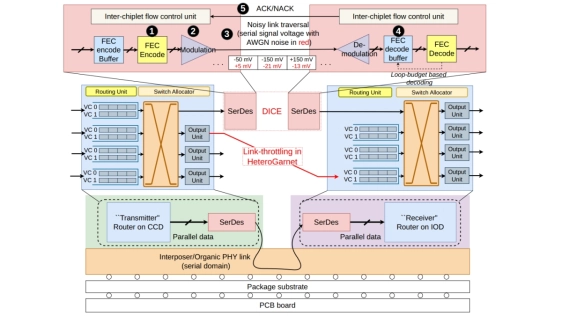
We present DICE, an in-simulation, runtime PHY modeling in gem5 that captures the end-to-end inter-chiplet datapath, including QC-LDPC encoding/decoding, PAM4 modulation, lossy-channel transmission, LLR-based demodulation, adaptive packet re-sending, and PHY-level flow control between chiplets. For fidelity, we calibrate component latencies via hardware synthesis (e.g., QC-LDPC decode paths and iteration budgets) and compare the integrated system against production chiplet processors. Compared with state-of-theart fixed-latency inter-chiplet links such as HeteroGarnet, DICE reshapes packet-latency composition and shifts system IPC by an average of 6.8% and up to 27.6%, revealing variability driven by realistic PHY link behaviors, enabling more accurate co-evaluation of performance, reliability, and design trade-offs in modern chiplet systems.
To read the full article, click here
Related Chiplet
- Optical Chiplet
- Reverse Gearbox Chiplet
- FlexGen Multi-Die Smart Network-on-Chip (NoC) IP
- Ncore Multi-Die Interconnect IP
- Integrated voltage regulator (IVR) chiplet
Related Technical Papers
- 3D-ICE 4.0: Accurate and efficient thermal modeling for 2.5D/3D heterogeneous chiplet systems
- Fast and Accurate Jitter Modeling for Statistical BER Analysis for Chiplet Interconnect and Beyond
- ATSim: A Fast and Accurate Simulation Framework for 2.5D/3D Chiplet Thermal Design Optimization
- Spatiotemporal thermal characterization for 3D stacked chiplet systems based on transient thermal simulation
Latest Technical Papers
- Technical Challenges for Ultra Fine Pitch Hybrid Bonding
- DT-MATCH: Defect- and Topology-Aware Chiplet Matching for Yield Optimization in Heterogeneous Integration
- Starscream: Reimagining LLM Sharding on AMD Instinct GPUs with GPU Partitioning
- Tri-Stack-PIM: A Heterogeneous Multi-Die 3D-Integrated Processing-in-Memory Architecture for Efficient LLM Inference
- CU-3D: A Scalable Legality-Aware RTL-to-GDS Flow for 3D-IC Physical Design