PICNIC: Silicon Photonic Interconnected Chiplets with Computational Network and In-memory Computing for LLM Inference Acceleration
By Yue Jiet Chong, Yimin Wang, Zhen Wu and Xuanyao Fong
National University of Singapore, Singapore
Abstract
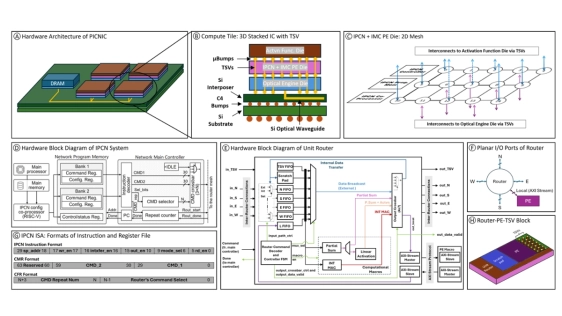
This paper presents a 3D-stacked chiplets based large language model (LLM) inference accelerator, consisting of non-volatile in-memory-computing processing elements (PEs) and Inter-PE Computational Network (IPCN), interconnected via silicon photonic to effectively address the communication bottlenecks. A LLM mapping scheme was developed to optimize hardware scheduling and workload mapping. Simulation results show it achieves 3.95× speedup and 30× efficiency improvement over the Nvidia A100 before chiplet clustering and power gating scheme (CCPG). Additionally, the system achieves further scalability and efficiency improvement with the implementation of CCPG to accommodate larger models, attaining 57× efficiency improvement over Nvidia H100 at similar throughput.
Index Terms: LLM Inference, Hardware Accelerator, HW-SW Co-design
To read the full article, click here
Related Chiplet
- Optical Chiplet
- Reverse Gearbox Chiplet
- FlexGen Multi-Die Smart Network-on-Chip (NoC) IP
- Ncore Multi-Die Interconnect IP
- Integrated voltage regulator (IVR) chiplet
Related Technical Papers
- CHIPSMORE: Compute-in-Interconnect and -Memory Chiplets for Multi-Mode Multi-Request LLM Inference Acceleration
- FLINT: Efficiently Leveraging High Bandwidth Flash for Capacity-Scalable LLM Inference Acceleration
- ChipAI: A scalable chiplet-based accelerator for efficient DNN inference using silicon photonics
- Inter-Layer Scheduling Space Exploration for Multi-model Inference on Heterogeneous Chiplets
Latest Technical Papers
- Adaptive 3D Chiplet Architecture with Hybrid Wired–Wireless Interconnect for Energy-Efficient Heterogeneous Computing
- LLM-Augmented Bayesian Optimization with Adaptive Policies for Chiplet Design Space Exploration
- Divide and conquer: Scalable performance and energy in MCM GPUs
- A Composable AI-Accelerated Iterative Solver for 3D-IC Thermal Modeling
- QBX: A Compiler for 2-local Qubit Hamiltonian Simulation on Quantum Chiplets