Scalable 3D hybrid integrated photonic computing chiplets
By Hang Song 1, Chao-Qian Li 1, Yun-Long Nie 1, Yu-Xuan Fu 1, De-Hui Huang 1, Yi Xie 1, Yu-Lin Yu 2, Chao-Yang Zhang 2, Chun-Yan Jin 2, Yang Shu 3, Zhe-Han Li 2, Kuan Huang 2, Hao Tang 1,3,4 & Xian-Min Jin 1,2,3,4
1 Center for Integrated Quantum Information Technologies (IQIT), School of Physics and Astronomy, State Key Laboratory of Photonics and Communications, Shanghai Jiao Tong University, Shanghai, China.
2 TuringQ Co., Ltd., Shanghai, China.
3 Chip Hub for Integrated Photonics Xplore (CHIPX), Shanghai Jiao Tong University, Wuxi, China.
4 Hefei National Laboratory, Hefei, China
Abstract
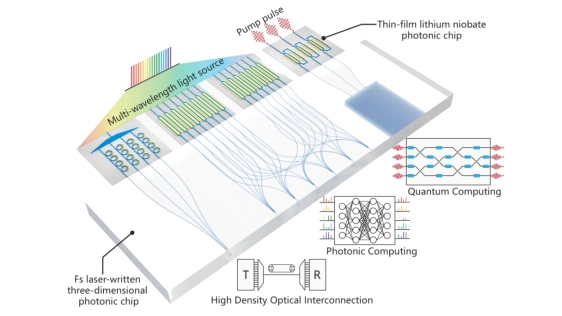
The exponential surge in artificial intelligence computing power demand is driving a transition from electrons to photons across the infrastructure. Although integrated photonics has revolutionized communications and computing, its scaling for large-scale information processing is constrained by monolithic scalability, modulation efficiency, and multi-chip integration. Here, we present HyPec, a hybrid photonic extensible chiplet architecture that synergizes thin-film lithium niobate modulation chiplets with femtosecond laser-written three-dimensional functional chiplets. Through function disaggregation, HyPec partitions high-performance active modulation from the 3D photonic routing network. This chiplet architecture facilitates seamless multi-chip connectivity across diverse material platforms to achieve aggregate performance beyond monolithic limits, thereby allowing the system to scale through the addition of functional chiplets. To validate the advantages of this architecture, we experimentally built a co-packaged photonic computing chiplet system that implements a scalable graph solver and further identifies critical protein residues in structural biology networks. This work establishes a scalable hardware path for integrated photonic computing, with broader implications for high-density optical interconnects and photonic quantum information systems.
To read the full article, click here
Related Chiplet
- Optical Chiplet
- Reverse Gearbox Chiplet
- FlexGen Multi-Die Smart Network-on-Chip (NoC) IP
- Ncore Multi-Die Interconnect IP
- Integrated voltage regulator (IVR) chiplet
Related Technical Papers
- Monolithically Integrated Optical Through-Silicon Waveguides for 3D Chip-to-Chip Photonic Interconnects
- PICNIC: Silicon Photonic Interconnected Chiplets with Computational Network and In-memory Computing for LLM Inference Acceleration
- Advances in waveguide to waveguide couplers for 3D integrated photonic packaging
- AI-Driven Thermal Mapping and Management in 3D Integrated Photonic Circuits
Latest Technical Papers
- Scalable 3D hybrid integrated photonic computing chiplets
- PAISF: A Partially Adaptive In-Order Selection Function for Routing in On-Chip, Inter-Chiplet, and Wafer-Scale Networks
- LASH-PAT: Deadlock-Free Adaptive Shortest-Path Routing for Inter-Chiplet Interconnects
- ThermLeT: Transformer-based Temperature Prediction for 2.5D Chiplet Architecture
- Technical Challenges for Ultra Fine Pitch Hybrid Bonding