Plasma Etch Process Optimization for Photonic-Grade Diamond-on-Insulator Substrates and Thickness Evaluation using Colorimetry
By Tianyin Chen, Alessio Mirandaa, Leyla Ramia, Ryoichi Ishiharaa, Salahuddin Nur
Delft University of Technology, The Netherlands
Abstract
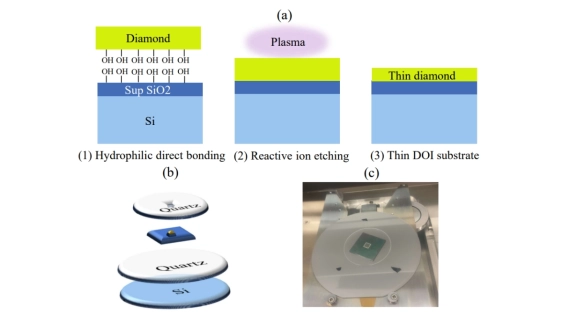
Diamond color-center qubits integrated with photonic circuits can be initialized, manipulated, entangled, and read individually with high fidelity, making them attractive for large-scale modular quantum computers, quantum networks, and distributed quantum sensing. However, the limited size of heteroepitaxially grown single-crystal diamond (SCD) and photonic-grade diamond-on-insulator (DOI) substrates remains a challenge for integration with existing manufacturing processes. Here, we develop a plasma etch recipe to thin direct-bonded (100) SCD membranes (<50 µm) into large-area, thin-film DOI substrates, and demonstrate free-standing photonic chiplets fabricated from the resulting DOI. The ICP-RIE recipe preserves diamond bonding, provides sufficient micromasking and surface-quality control, and enables thin-film DOI manufacture. We thin a 10 µm diamond plate bonded to SiO₂/Si and obtain a photonic-grade DOI substrate with diamond thickness ≤300 nm. The DOI film is around 300 nm thick over 0.5 x 0.5 mm², with surface roughness < 0.5 nm, while the bonding interface remains intact. Diamond photonic chiplets are fabricated on this DOI substrate using a standard two-step lithography process, without complex thin-film transfer, under-etching, or pedestal formation. We also present a colorimetric study of diamond visibility on SiO₂ and quantify color differences across thicknesses in common colorimetric spaces. This analysis enables automatic diamond-thickness extrapolation from standard optical microscope images with 5 nm resolution, in good agreement with white-light interferometry (WLI) measurements. The DOI substrate and colorimetric thickness-evaluation method provide an effective fabrication platform and reliable validation route for scalable manufacturing of diamond nanophotonic devices, opening a path toward large-scale integrated quantum systems.
To read the full article, click here
Related Chiplet
- Optical Chiplet
- Reverse Gearbox Chiplet
- FlexGen Multi-Die Smart Network-on-Chip (NoC) IP
- Ncore Multi-Die Interconnect IP
- Integrated voltage regulator (IVR) chiplet
Related Technical Papers
- Wafer Warpage of Silicon Interposer in Manufacturing Processes for High Density 2.5D Advanced Packaging: Causes, Measurement, Analysis and Optimization
- Development and Optimization of Fine-Pitch RDL for RDL Interposer, and Embedded Bridge Die Interposer Fabrication Using Fan-Out Wafer-Level Packaging Technology
- CarbonPATH: Carbon-aware pathfinding and architecture optimization for chiplet-based AI systems
- Rethinking Compute Substrates for 3D-Stacked Near-Memory LLMDecoding: Microarchitecture–Scheduling Co-Design
Latest Technical Papers
- Beyond Host-Side Control: HBM Controller Partitioning Across Host and HBM Base Dies
- Chiplet-NAS: Chiplet-aware Neural Architecture Search for Efficient AI Inference on 2.5D Integration
- Scaling Up Analog CIM: A Simulation Framework for Topology-Aware Mapping
- AI-Based Image Enhancement Improves Detection of Interconnect Defects in Microelectronic Packaging
- Embodied Emissions of 2.5D and 3D Scaling in Chipletized GPUs for Low-Carbon AI