Optimizing Attention on GPUs by Exploiting GPU Architectural NUMA Effects
By Mansi Choudhary 1, Karthik Sangaiah 2, Sonali Singh 2, Muhammad Osama 2, Lisa Wu Wills 3, Ganesh Dasika 2
1 Department of ECE, Duke University, Durham, USA
2 Advanced Micro Devices Inc., Santa Clara, USA
3 Department of Computer Science, Duke University, Durham, USA
Abstract
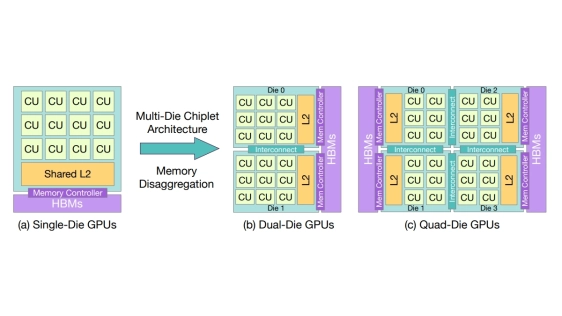
The rise of disaggregated AI GPUs has exposed a critical bottleneck in large-scale attention workloads: non-uniform memory access (NUMA). As multi-chiplet designs become the norm for scaling compute capabilities, memory latency and bandwidth vary sharply across compute regions, undermining the performance of traditional GPU kernel scheduling strategies that assume uniform memory access. We identify how these NUMA effects distort locality in multi-head attention (MHA) and present Swizzled Head-first Mapping, a spatially-aware scheduling strategy that aligns attention heads with GPU NUMA domains to exploit intra-chiplet cache reuse. On AMD's MI300X architecture, our method achieves up to 50% higher performance over state-of-the-art attention algorithms using conventional scheduling techniques and sustains consistently high L2 cache hit rates of 80-97%. These results demonstrate that NUMA-aware scheduling is now fundamental to achieving full efficiency on next-generation disaggregated GPUs, offering a path forward for scalable AI training and inference.
To read the full article, click here
Related Chiplet
- FlexGen Multi-Die Smart Network-on-Chip (NoC) IP
- Ncore Multi-Die Interconnect IP
- Integrated voltage regulator (IVR) chiplet
- High-performance connectivity chiplets
- eFPGA Chiplet
Related Technical Papers
- Fleet: Hierarchical Task-based Abstraction for Megakernels on Multi-Die GPUs
- Making Locality-aware GEMM Compatible with Page-Granularity Placement on Chiplet GPUs
- Effects of Poor Workload Partitioning on System Performance for Chiplet-Based Systems
- Architecting the Next Generation of Asynchronous, Distributed GPUs for the AI Era
Latest Technical Papers
- Divide and conquer: Scalable performance and energy in MCM GPUs
- A Composable AI-Accelerated Iterative Solver for 3D-IC Thermal Modeling
- QBX: A Compiler for 2-local Qubit Hamiltonian Simulation on Quantum Chiplets
- U-Can-Inject-Errors (UCIe): A Protocol-Aware Hardware Trojan for FPGA Chiplet Links
- The Power of Indirection: Scaling Switches Beyond Silicon Boundaries