Modeling, Optimizing and Exploring Multi-Die FPGA Routing Architectures
By Amirhossein Poolad †, Soheil Gholami Shahrouz †, Andrew Boutros ‡, and Vaughn Betz †
† University of Toronto, Canada
‡ University of Waterloo, Canada
Abstract
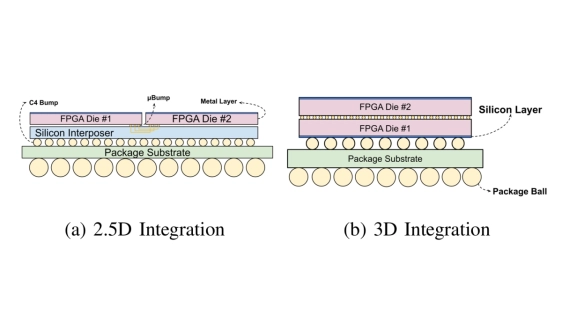
Die stacking has enabled 2.5D FPGAs by integrating multiple active dice on a passive silicon interposer for improved yield and capacity, and paved the way for 3D architectures that stack active dice directly atop one another. In these multi-die devices, the unique electrical and physical characteristics of the underlying die-stacking technology impose limitations on inter-die connection density and latency, necessitating a bespoke inter-die routing architecture. However, the absence of accurate and versatile modeling tools has left most questions about how to best design the inter-die routing architecture unanswered.
To address this gap, we enhance the open-source FPGA CAD tool VTR to flexibly model a wide range of multi-die routing architectures, and augment VPR's placement and routing engines to improve optimization for both 2.5D and 3D FPGAs. We perform HSPICE-based circuit modeling of inter-die connections for active dice using a 7 nm process node and a 45 nm silicon interposer across several die-crossing technologies. Using this enhanced framework, we conduct a detailed design space exploration of inter-die routing architecture in 2.5D and 3D FPGAs, characterizing the impact of die-crossing technology, inter-die connection count, fan-in/fan-out, and interposer wire length on critical path delay (CPD), wirelength, area, and routability.
Our results show that with suitable inter-die routing architectures, 2.5D and 3D FPGAs can increase capacity without significant routability or delay penalties. Specifically, 3D FPGAs achieve up to 14% wirelength reduction and 6% CPD improvement over 2D devices, and remain routable even with existing 10µm pitch technologies, while 2.5D FPGAs incur only a 2% wirelength and 4% CPD overhead at 32% inter-die connectivity. All extensions are open source and integrated with the VTR master branch.
Index Terms — 2.5D FPGA, Silicon interposer, 3D FPGA, FPGA architecture, FPGA routing architecture
To read the full article, click here
Related Chiplet
- Optical Chiplet
- Reverse Gearbox Chiplet
- FlexGen Multi-Die Smart Network-on-Chip (NoC) IP
- Ncore Multi-Die Interconnect IP
- Integrated voltage regulator (IVR) chiplet
Related Technical Papers
- MFIT : Multi-FIdelity Thermal Modeling for 2.5D and 3D Multi-Chiplet Architectures
- REFRESH FPGAs: Sustainable FPGA Chiplet Architectures
- Modeling and Controlling Many-Core HPC Processors: an Alternative to PID and Moving Average Algorithms
- NoCs and the transition to multi-die systems using chiplets
Latest Technical Papers
- Adaptive 3D Chiplet Architecture with Hybrid Wired–Wireless Interconnect for Energy-Efficient Heterogeneous Computing
- LLM-Augmented Bayesian Optimization with Adaptive Policies for Chiplet Design Space Exploration
- Divide and conquer: Scalable performance and energy in MCM GPUs
- A Composable AI-Accelerated Iterative Solver for 3D-IC Thermal Modeling
- QBX: A Compiler for 2-local Qubit Hamiltonian Simulation on Quantum Chiplets