Dispersion-Engineered Terahertz Silicon Interconnects Enabling Terabit-Scale Data Links
By Bodhan Chakraborty 1,2, Wenhao Wang 3, Nikhil Navaratna 1,2, Thomas Caiwei Tan 1,2, Pascal Szriftgiser 4, Hadjer Nihel Khelil 5, Guillaume Ducournau 5, and Ranjan Singh 6
1 Division of Physics and Applied Physics, School of Physical and Mathematical Sciences, Nanyang Technological University, Singapore, 637371, Singapore
2 Centre for Disruptive Photonic Technologies, The Photonics Institute, Nanyang Technological University, Singapore, 639798, Singapore
3 Department of Electronic and Information Engineering, School of Engineering, Westlake University, Hangzhou 310030, China
4 Université de Lille, CNRS, UMR 8523 – PhLAM, Laboratoire de Physique des Lasers, Atomes et Molécules, Lille, France
5 Université de Lille, CNRS, UMR 8520 – IEMN, Institut dʹElectronique Microelectronique et Nanotechnologie, Lille, France
6 Department of Electrical Engineering, University of Notre Dame, Notre Dame, IN 46556, USA
Abstract
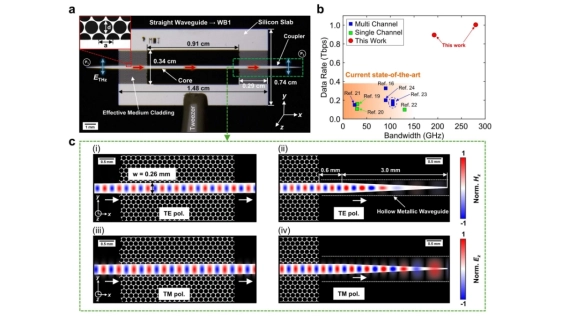
The rapid growth of artificial intelligence (AI) and data-centric computing is driving exabyte-scale data transfer, pushing conventional interconnect technologies toward fundamental bandwidth and energy limits. Although optical interconnects provide high-capacity and long-reach communication, their complexity and energy overhead limit scalability in short-reach chiplet-based and on-chip systems. Terahertz (THz) silicon interconnects offer a promising alternative by bridging electronics and photonics in compact, complementary metal-oxide-semiconductor (CMOS)-compatible platforms capable of high bandwidth and low latency. However, practical THz interconnects require simultaneous multi-band operation, dual-polarization support, low propagation loss, low group-velocity dispersion (GVD), and terabit-per-second throughput, while avoiding Bragg-induced stopbands and dispersion penalties at high frequencies. Here, we demonstrate a CMOS-compatible, centimetre-scale, multi-band on-chip THz data link achieving an aggregate throughput of 1.004 Tbps. The performance is enabled by suppressing Bragg-induced stopbands using dispersion-engineered, effective-medium-supported unclad silicon waveguides, resulting in flat transmission and low-ripple group delay across multiple THz bands. The waveguide platform operates from 220 to 500 GHz and supports both transverse-electric (TE) and transverse-magnetic (TM) polarizations with low path loss, low bending loss, and low GVD. Fourteen channels in a straight waveguide and twelve channels in a 90° bend achieve aggregate data rates of 1.004 Tbps and 0.895 Tbps, respectively, with GVD as low as 0.15 ps2/mm over the full operating band. These results establish a scalable and energy-efficient THz interconnect platform for high-density on-chip and chip-to-chip communication fabrics targeting next-generation AI systems and emerging 6G technologies.
To read the full article, click here
Related Chiplet
- Optical Chiplet
- Reverse Gearbox Chiplet
- FlexGen Multi-Die Smart Network-on-Chip (NoC) IP
- Ncore Multi-Die Interconnect IP
- Integrated voltage regulator (IVR) chiplet
Related Technical Papers
- Three-dimensional photonic integration for ultra-low-energy, high-bandwidth interchip data links
- Intel Delivers Cutting-Edge Process Technologies to the Data Center with Intel 18A and Advanced Chiplet Packaging
- Dual-Stripline Configuration for Efficient Routing in Chiplet Interconnects
- SPIRAL: Signal-Power Integrity Co-Analysis for High-Speed Inter-Chiplet Serial Links Validation
Latest Technical Papers
- Adaptive 3D Chiplet Architecture with Hybrid Wired–Wireless Interconnect for Energy-Efficient Heterogeneous Computing
- LLM-Augmented Bayesian Optimization with Adaptive Policies for Chiplet Design Space Exploration
- Divide and conquer: Scalable performance and energy in MCM GPUs
- A Composable AI-Accelerated Iterative Solver for 3D-IC Thermal Modeling
- QBX: A Compiler for 2-local Qubit Hamiltonian Simulation on Quantum Chiplets