FLINT: Efficiently Leveraging High Bandwidth Flash for Capacity-Scalable LLM Inference Acceleration
By Geraldo F. Oliveira †, Vamanan Arulchelvan †, Jia Xinglei ‡, Arash Tavakkol †, Lukas Cavigelli †, Onur Mutlu §, Xiangyu Zhu †, Renzo Andri †, Zhou Ke ∇, Ahmet Caner Yüzügüler †, Mohammad Sadrosadati †, Shai Bergman †, Ji Zhang ‡
† Huawei Technologies Switzerland AG
‡ Huawei Technologies Co., Ltd.
§ ETH Zürich
∇ HUST
Abstract
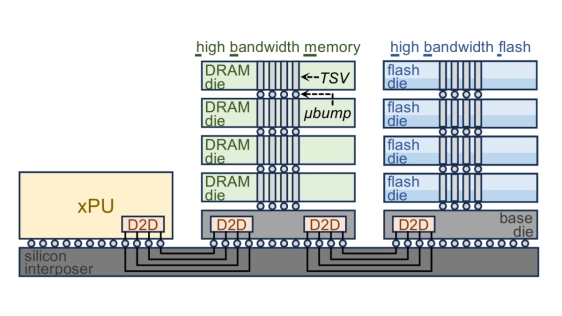
LLM inference is increasingly constrained by accelerator memory capacity rather than compute throughput. This constraint is especially acute in single-accelerator and small-node inference systems, where limited on-package memory capacity restricts the size of deployable models. HBF is an emerging 3D-stacked NAND flash technology that provides multi-terabyte near-accelerator capacity, making it a promising capacity tier for storing LLM weights. However, existing HBF-based proposals face three adoption challenges: they (1) rely on coarse-grained static prefetching for LLM weights aiming to hide the microsecond-level read latency of the NAND flash device while maximizing HBF's read throughput, (2) expose NAND flash management tasks (e.g., refresh operations) to the accelerator-visible critical inference path, and (3) miss optimization opportunities to specialize and optimize the flash-management mechanisms to the workload behavior.
Our goal is to design an efficient HBF substrate that integrates HBF as a memory-capacity tier alongside HBM while addressing these three challenges. To this end, we propose FLINT, a workload-driven HBF substrate for capacity-scalable LLM inference. FLINT introduces three mechanisms: (1) a hardware burst-buffer controller that dynamically coalesces and pipelines HBF reads aiming to utilize existing NAND flash buffers while sustaining high HBF bandwidth, (2) a phantom-plane refresh mechanism, which removes refresh from the critical inference path by moving refresh-related NAND flash operations outside the read foreground back via low-cost resource duplication, and (3) a read-only FTL, which replaces SSD-class support for arbitrary writes with a compact table that translates logical weight bursts to physical HBF locations.
We evaluate FLINT across dense and mixture-of-experts (MoE) LLM inference models. Our evaluation shows that FLINT improves decode throughput by 1,205×, 2.2×, and 6.2×, and reduces energy consumption by 408×, 1.1×, and 6.8× that of an SSD-equipped GPU system, an HBM-only GPU system, and a prior hybrid HBM+HBF GPU system, respectively. FLINT meets a 50ms time per output token (TPOT) service-level objective (SLO) with 3.1× fewer GPU packages than the HBM-only GPU system. FLINT adds small area cost to an HBF die (3.1%) and HBF base die (3.9 mm2 at 7nm).
To read the full article, click here
Related Chiplet
- Optical Chiplet
- Reverse Gearbox Chiplet
- FlexGen Multi-Die Smart Network-on-Chip (NoC) IP
- Ncore Multi-Die Interconnect IP
- Integrated voltage regulator (IVR) chiplet
Related Technical Papers
- PICNIC: Silicon Photonic Interconnected Chiplets with Computational Network and In-memory Computing for LLM Inference Acceleration
- CHIPSMORE: Compute-in-Interconnect and -Memory Chiplets for Multi-Mode Multi-Request LLM Inference Acceleration
- Compass: Mapping Space Exploration for Multi-Chiplet Accelerators Targeting LLM Inference Serving Workloads
- Mapping Space Exploration for Multi-Chiplet Accelerators Targeting LLM Inference Serving Workloads
Latest Technical Papers
- Adaptive 3D Chiplet Architecture with Hybrid Wired–Wireless Interconnect for Energy-Efficient Heterogeneous Computing
- LLM-Augmented Bayesian Optimization with Adaptive Policies for Chiplet Design Space Exploration
- Divide and conquer: Scalable performance and energy in MCM GPUs
- A Composable AI-Accelerated Iterative Solver for 3D-IC Thermal Modeling
- QBX: A Compiler for 2-local Qubit Hamiltonian Simulation on Quantum Chiplets