EOTPR Fine Pitch Probing for Die-to-Die Interconnect Failure Analysis
By Bernice Zee 1, Wen Qiu 1, Aaron Wai Ken Lee 1, Jesse Alton 2, Thomas White 2, David Kim 2, Martin Igarashi 2
1 Advanced Micro Devices (Singapore) Pte Ltd, Singapore
2 TeraView Limited, United Kingdom
Abstract
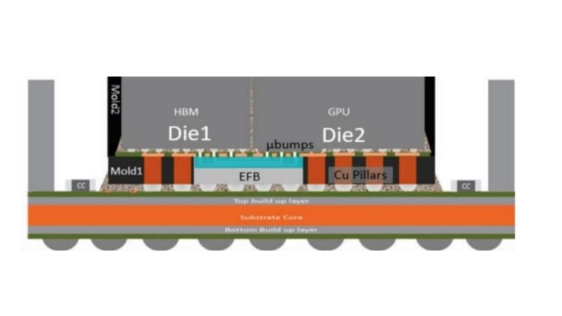
Debug and physical failure analysis (PFA) of heterogeneously integrated semiconductor packages, particularly die-to-die (D2D) input/output (I/O) type fails, has become very challenging due to the lack of direct access to the I/Os from the package substrate to do static open/shorts fault isolation and limited test program granularity to determine which location along the D2D interconnect trace is failing. Thus, a suitable electrical fault isolation technique is required to ensure high success rate for root cause analysis. This paper discusses how EOTPR is used to isolate defects on a D2D interconnect trace of a chiplet advanced packaging using local silicon bridge with reasonable accuracy. Minimal sample preparation was needed to expose the I/O bumps for probing, thus minimizing the risk of artifacts that may cause the defect to be lost. A case study will demonstrate the successful application of the technique.
Keywords: chiplet packaging, die-to-die interconnect failure analysis, electrical fault isolation, electro-optical terahertz pulse reflectometry fine pitch probing, heterogeneous integration, physical failure analysis, sample preparation, silicon bridge
To read the full article, click here
Related Chiplet
- Optical Chiplet
- Reverse Gearbox Chiplet
- FlexGen Multi-Die Smart Network-on-Chip (NoC) IP
- Ncore Multi-Die Interconnect IP
- Integrated voltage regulator (IVR) chiplet
Related Technical Papers
- Chiplet-Escape: An Efficient Obstacle-Avoiding Escape Routing Method for Die-to-Die Interconnections in Chiplet-Based Designs
- Thermal Tuning Overhead in Wafer-Scale Optical Interconnects for LLM MoE Training: A Cross-Layer Analysis and Ferroelectric-Based Mitigation
- Probeless Fault Isolation Capability for 2.5D/3D Chiplet Die-to-Die Interconnect
- Fast and Accurate Jitter Modeling for Statistical BER Analysis for Chiplet Interconnect and Beyond
Latest Technical Papers
- Adaptive 3D Chiplet Architecture with Hybrid Wired–Wireless Interconnect for Energy-Efficient Heterogeneous Computing
- LLM-Augmented Bayesian Optimization with Adaptive Policies for Chiplet Design Space Exploration
- Divide and conquer: Scalable performance and energy in MCM GPUs
- A Composable AI-Accelerated Iterative Solver for 3D-IC Thermal Modeling
- QBX: A Compiler for 2-local Qubit Hamiltonian Simulation on Quantum Chiplets