Corsair: An In-memory Computing Chiplet Architecture for Inference-time Compute Acceleration
By Satyam Srivastava; Akhil Arunkumar; Nithesh Kurella; Amrit Panda; Gaurav Jain; Purushotham Kamath
d-Matrix Corporation
Abstract:
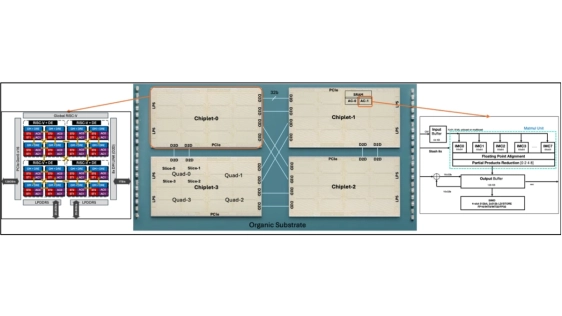
Advances in Generative AI (GenAI) have reinvigorated research into novel computing architectures such as Transformer. Transformer, characterized by low arithmetic intensity during most of the inference time, has become the cornerstone of GenAI underlying Large Language (LLM) and Reasoning Models (RM). Numerous solutions to the intense memory bandwidth problem have been proposed. Corsair is an architecture that targets this need using chiplet design, digital in-memory computing-based matrix engine, efficient die-to-die interconnects, block floating point numerics, and large high-bandwidth on-chip memories. We describe the Corsair chiplet, scaling approaches to compose larger systems, and outline the software stack. We formulate the inference-time requirements of LLM and RM computation, memory bandwidth, memory capacity, and interconnect efficiency for scaling. We also show how Corsair design perfectly fits these workloads. We present benchmark results from Corsair silicon that correlate strongly with the design and preview an estimate of workload-level improvements expected with Corsair.
To read the full article, click here
Related Chiplet
- Optical Chiplet
- Reverse Gearbox Chiplet
- FlexGen Multi-Die Smart Network-on-Chip (NoC) IP
- Ncore Multi-Die Interconnect IP
- Integrated voltage regulator (IVR) chiplet
Related Technical Papers
- PICNIC: Silicon Photonic Interconnected Chiplets with Computational Network and In-memory Computing for LLM Inference Acceleration
- CHIPSMORE: Compute-in-Interconnect and -Memory Chiplets for Multi-Mode Multi-Request LLM Inference Acceleration
- APEX: an Adaptive Photonic-Electronic Chiplet Interconnection Architecture for DNN Inference
- Adaptive 3D Chiplet Architecture with Hybrid Wired–Wireless Interconnect for Energy-Efficient Heterogeneous Computing
Latest Technical Papers
- Adaptive 3D Chiplet Architecture with Hybrid Wired–Wireless Interconnect for Energy-Efficient Heterogeneous Computing
- LLM-Augmented Bayesian Optimization with Adaptive Policies for Chiplet Design Space Exploration
- Divide and conquer: Scalable performance and energy in MCM GPUs
- A Composable AI-Accelerated Iterative Solver for 3D-IC Thermal Modeling
- QBX: A Compiler for 2-local Qubit Hamiltonian Simulation on Quantum Chiplets