CLIPGen: A Chiplet Link IP Modeling and Generation Framework for 2.5D Architecture Exploration
By Zhengping Zhu, Austin Rovinski
New York University
Abstract
Advanced 2.5D Systems-in-Package (SiPs) compose a growing portion of high-performance systems. While the packaging and interconnect choices play a large role in the overall system design, system architects still lack a suitable framework for early design space exploration which takes these choices into account. Current interconnect models fall mostly into the categories of 1) detailed models which are generally inflexible and require deep packaging expertise, or 2) high-level models which don't provide enough information to make accurate architectural design decisions.
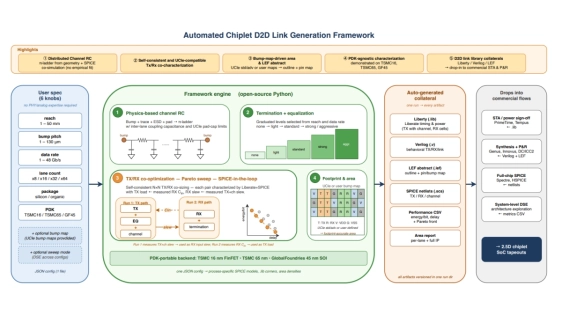
In this work, we present an automated chiplet IP generation framework which provides power, performance, and area estimates for various 2.5D packaging and communication configurations. The IP generator produces standard collaterals required for high-level simulation/estimation, RTL simulation, and place-and-route-level implementation (Verilog, Liberty, LEF, and datasheet). Using our framework, architects can co-optimize the package and chiplet architecture through rapid power, performance, and area estimates of various packaging strategies. As a case study, we examine generated UCIe interfaces across several packaging options.
Keywords: 2.5D, IP, Die-to-die link modeling
To read the full article, click here
Related Chiplet
- Optical Chiplet
- Reverse Gearbox Chiplet
- FlexGen Multi-Die Smart Network-on-Chip (NoC) IP
- Ncore Multi-Die Interconnect IP
- Integrated voltage regulator (IVR) chiplet
Related Technical Papers
- MFIT : Multi-FIdelity Thermal Modeling for 2.5D and 3D Multi-Chiplet Architectures
- ATPlace2.5D: Analytical Thermal-Aware Chiplet Placement Framework for Large-Scale 2.5D-IC
- ATSim: A Fast and Accurate Simulation Framework for 2.5D/3D Chiplet Thermal Design Optimization
- 3D-ICE 4.0: Accurate and efficient thermal modeling for 2.5D/3D heterogeneous chiplet systems
Latest Technical Papers
- Starscream: Reimagining LLM Sharding on AMD Instinct GPUs with GPU Partitioning
- Tri-Stack-PIM: A Heterogeneous Multi-Die 3D-Integrated Processing-in-Memory Architecture for Efficient LLM Inference
- CU-3D: A Scalable Legality-Aware RTL-to-GDS Flow for 3D-IC Physical Design
- Beyond Host-Side Control: HBM Controller Partitioning Across Host and HBM Base Dies
- Chiplet-NAS: Chiplet-aware Neural Architecture Search for Efficient AI Inference on 2.5D Integration