Advanced semiconductor packaging design via artificial intelligence and machine learning: A review
By Mohammad Rafiee, Pavas Saini
University of Ottawa, Canada
Abstract
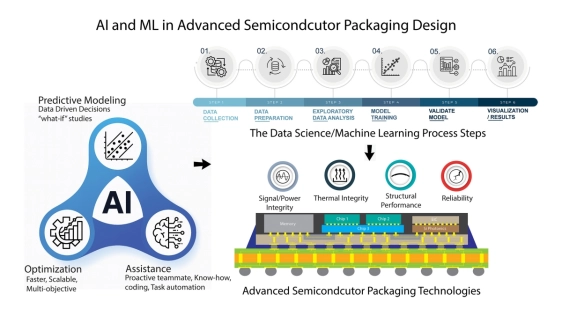
System performance now depends as much on advanced semiconductor packaging as on transistor scaling, especially with chiplets, 2.5D interposers, and 3D stacks. The resulting electro-thermal-mechanical coupling makes conventional electromagnetic (EM), finite-element (FEM), and computational fluid dynamics (CFD) analysis costly for design-space exploration. This review synthesizes how artificial intelligence (AI) and machine learning (ML) accelerate and augment packaging workflows across four domains—signal/power integrity (SI/PI), thermal integrity, structural/assembly behavior (warpage and stress), and reliability—and how AI and ML enables multi-physics co-design. We organize prior work by design role (surrogate modeling, design tuning, time-series tracking and multi objective co- design) and by algorithm family for fast surrogates; deep models (convolutional neural networks and long short-term memory networks) for images and waveforms; emerging reinforcement learning for routing, stack-up, and parameter auto-tuning; and physics-informed networks for thermally constrained settings. Cross-domain analysis reveals which models generalize broadly and which are specialized for data types or physics constraints. Remaining challenges for industrial adoption include reliance on simulation-only datasets, limited generalizability across architectures, incomplete uncertainty quantification, and interpretability concerns. We emphasize ongoing opportunities in integrating physics knowledge, uncertainty-aware learning, digital twin frameworks, transfer- and semi-supervised learning strategies, standardized benchmarking, and embedding AI and ML into electronic design automation (EDA) flows. Overall, AI and ML are advancing semiconductor packaging from simulation-driven iteration toward learning-augmented co-design, enabling more efficient, robust, and holistic optimization.
Keywords: AI/ML in advanced semiconductor packaging; Signal and power integrity; Thermal management; Package warpage and stress; Microelectronics reliability; Multi-physics co-design
To read the full article, click here
Related Chiplet
- Optical Chiplet
- Reverse Gearbox Chiplet
- FlexGen Multi-Die Smart Network-on-Chip (NoC) IP
- Ncore Multi-Die Interconnect IP
- Integrated voltage regulator (IVR) chiplet
Related Technical Papers
- Material Needs and Measurement Challenges for Advanced Semiconductor Packaging: Understanding the Soft Side of Science
- Thermo-mechanical co-design of 2.5D flip-chip packages with silicon and glass interposers via finite element analysis and machine learning
- Generative Design of Liquid-Cooling Channels for Thermal Management of 2.5D and 3D Integrated Advanced Packaging
- Intel Delivers Cutting-Edge Process Technologies to the Data Center with Intel 18A and Advanced Chiplet Packaging
Latest Technical Papers
- Adaptive 3D Chiplet Architecture with Hybrid Wired–Wireless Interconnect for Energy-Efficient Heterogeneous Computing
- LLM-Augmented Bayesian Optimization with Adaptive Policies for Chiplet Design Space Exploration
- Divide and conquer: Scalable performance and energy in MCM GPUs
- A Composable AI-Accelerated Iterative Solver for 3D-IC Thermal Modeling
- QBX: A Compiler for 2-local Qubit Hamiltonian Simulation on Quantum Chiplets