Toward Digital Twins in 3D IC Packaging: A Critical Review of Physics, Data, and Hybrid Architectures
By Gourab Datta, Sarah Safura Sharif, Yaser Mike Banad
School of Electrical and Computer Engineering, University of Oklahoma, Norman, 73019, U.S.A.
Abstract
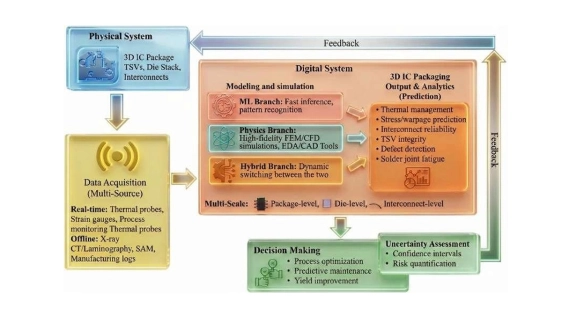
Three-dimensional integrated circuit (3D IC) packaging and heterogeneous integration have emerged as central pillars of contemporary semiconductor scaling. Yet, the multi-physics coupling inherent to stacked architectures manifesting as thermal hot spots, warpage-induced stresses, and interconnect aging demands monitoring and control capabilities that surpass traditional offline metrology. Although Digital Twin (DT) technology provides a principled route to real-time reliability management, the existing literature remains fragmented and frequently blurs the distinction between static multiphysics simulation workflows and truly dynamic, closed-loop twins. This critical review distinguishes itself by addressing these deficiencies through three specific contributions. First, we clarify the Digital Twin hierarchy to resolve terminological ambiguity between digital models, shadows, and twins. Second, we synthesize three foundational enabling technologies: (1) physics-based modeling, emphasizing the shift from computationally intensive finite-element analysis (FEA) to real-time surrogate models; (2) data-driven paradigms, highlighting virtual metrology (VM) for inferring latent metrics; and (3) in-situ sensing, the nervous system coupling the physical stack to its virtual counterpart. Third, beyond a descriptive survey, we propose a unified hybrid DT architecture that leverages physics-informed machine learning (e.g., PINNs) to reconcile data scarcity with latency constraints. Finally, we outline a standards-aligned roadmap incorporating IEEE 1451 and UCIe protocols to accelerate the transition from passive digital shadows to autonomous, self-optimizing Digital Twins for 3D IC manufacturing and field operation.
Index Terms — Digital twin, 3D IC packaging, Machine Learning, Physics-based simulation, Heterogeneous Integration
To read the full article, click here
Related Chiplet
- Optical Chiplet
- Reverse Gearbox Chiplet
- FlexGen Multi-Die Smart Network-on-Chip (NoC) IP
- Ncore Multi-Die Interconnect IP
- Integrated voltage regulator (IVR) chiplet
Related Technical Papers
- Reliability challenges in 3D IC semiconductor design
- Energy-/Carbon-Aware Evaluation and Optimization of 3-D IC Architecture With Digital Compute-in-Memory Designs
- Mastering multi-physics effects in 3D IC design
- Advances in waveguide to waveguide couplers for 3D integrated photonic packaging
Latest Technical Papers
- Adaptive 3D Chiplet Architecture with Hybrid Wired–Wireless Interconnect for Energy-Efficient Heterogeneous Computing
- LLM-Augmented Bayesian Optimization with Adaptive Policies for Chiplet Design Space Exploration
- Divide and conquer: Scalable performance and energy in MCM GPUs
- A Composable AI-Accelerated Iterative Solver for 3D-IC Thermal Modeling
- QBX: A Compiler for 2-local Qubit Hamiltonian Simulation on Quantum Chiplets