HexaMesh: Scaling to Hundreds of Chiplets with an Optimized Chiplet Arrangement
By Patrick Iff ∗, Maciej Besta ∗, Matheus Cavalcante †, Tim Fischer †, Luca Benini †‡ and Torsten Hoefler ∗
∗ Department of Computer Science, ETH Zurich, Zurich, Switzerland
† Department of Information Technology and Electrical Engineering, ETH Zurich, Zurich, Switzerland
‡ Dept. of Electrical, Electronic and Information Engineering, University of Bologna, Italy
Abstract
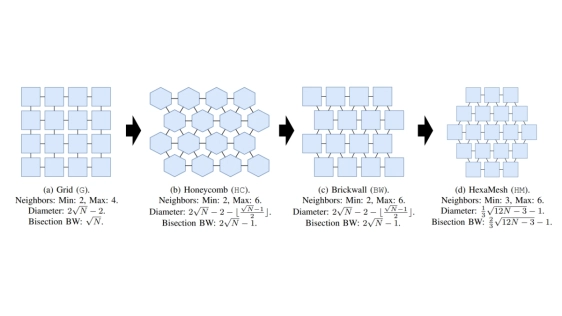
2.5D integration is an important technique to tackle the growing cost of manufacturing chips in advanced technology nodes. This poses the challenge of providing high-performance inter-chiplet interconnects (ICIs). As the number of chiplets grows to tens or hundreds, it becomes infeasible to hand-optimize their arrangement in a way that maximizes the ICI performance. In this paper, we propose HexaMesh, an arrangement of chiplets that outperforms a grid arrangement both in theory (network diameter reduced by 42%; bisection bandwidth improved by 130%) and in practice (latency reduced by 19%; throughput improved by 34%). HexaMesh enables large-scale chiplet designs with high-performance ICIs.
To read the full article, click here
Related Chiplet
- FlexGen Multi-Die Smart Network-on-Chip (NoC) IP
- Ncore Multi-Die Interconnect IP
- Integrated voltage regulator (IVR) chiplet
- High-performance connectivity chiplets
- eFPGA Chiplet
Related Technical Papers
- Leveraging Modularity of Chiplets to Form a 4×4 Automotive FMCW-Radar in an eWLB-Package
- Thermo-mechanical reliability evaluation and comparative fatigue assessment of 2.5D chiplet packages with viscoelastic C4 underfill
- High-Efficient and Fast-Response Thermal Management by Heterogeneous Integration of Diamond on Interposer-Based 2.5D Chiplets
- Hardware Design and Security in the Era of Chiplets and LLMs
Latest Technical Papers
- Divide and conquer: Scalable performance and energy in MCM GPUs
- A Composable AI-Accelerated Iterative Solver for 3D-IC Thermal Modeling
- QBX: A Compiler for 2-local Qubit Hamiltonian Simulation on Quantum Chiplets
- U-Can-Inject-Errors (UCIe): A Protocol-Aware Hardware Trojan for FPGA Chiplet Links
- The Power of Indirection: Scaling Switches Beyond Silicon Boundaries