ECO-CHIP: Estimation of Carbon Footprint of Chiplet-based Architectures for Sustainable VLSI
By Chetan Choppali Sudarshan 1, Nikhil Matkar 1, Sarma Vrudhula 1, Sachin S. Sapatnekar 2, and Vidya A. Chhabria 1
1 Arizona State University
2 University of Minnesota
Abstract
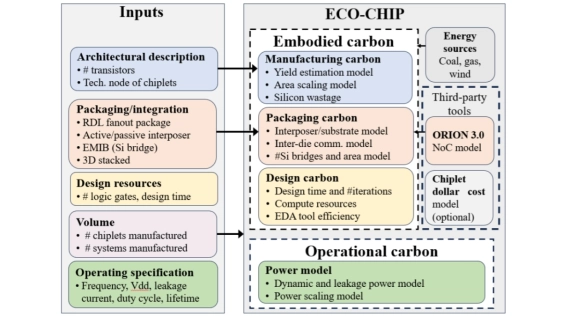
Decades of progress in energy-efficient and lowpower design have successfully reduced the operational carbon footprint in the semiconductor industry. However, this has led to increased embodied emissions, arising from design, manufacturing, and packaging. While existing research has developed tools to analyze embodied carbon for traditional monolithic systems, these tools do not apply to near-mainstream heterogeneous integration (HI) technologies. HI systems offer significant potential for sustainable computing by minimizing carbon emissions through two key strategies: “reducing” computation by “reusing” pre-designed chiplet IP blocks and adopting hierarchical approaches to system design. The reuse of chiplets across multiple designs, even spanning multiple generations of ICs, can substantially reduce carbon emissions throughout the lifespan. This paper introduces ECO-CHIP, a carbon analysis tool designed to assess the potential of HI systems toward sustainable computing by considering scaling, chiplet, and packaging yields, design complexity, and even overheads associated with advanced packaging techniques. Experimental results from ECO-CHIP demonstrate that HI can reduce embodied carbon emissions by up to 30% compared to traditional monolithic systems. ECOCHIP is integrated with other chiplet simulators and is applied to chiplet disaggregation considering other metrics such as power, area, and cost. ECO-CHIP suggests that HI can pave the way for sustainable computing practices.
To read the full article, click here
Related Chiplet
- Optical Chiplet
- Reverse Gearbox Chiplet
- FlexGen Multi-Die Smart Network-on-Chip (NoC) IP
- Ncore Multi-Die Interconnect IP
- Integrated voltage regulator (IVR) chiplet
Related Technical Papers
- Chiplet-Based Architectures: Redefining the Future of System-on-Chip (SoC) Design
- Simulation-Driven Evaluation of Chiplet-Based Architectures Using VisualSim
- Effects of Poor Workload Partitioning on System Performance for Chiplet-Based Systems
- CHICO-Agent: An LLM Agent for the Cross-layer Optimization of 2.5D and 3D Chiplet-based Systems
Latest Technical Papers
- Adaptive 3D Chiplet Architecture with Hybrid Wired–Wireless Interconnect for Energy-Efficient Heterogeneous Computing
- LLM-Augmented Bayesian Optimization with Adaptive Policies for Chiplet Design Space Exploration
- Divide and conquer: Scalable performance and energy in MCM GPUs
- A Composable AI-Accelerated Iterative Solver for 3D-IC Thermal Modeling
- QBX: A Compiler for 2-local Qubit Hamiltonian Simulation on Quantum Chiplets