Chiplet technology for large-scale trapped-ion quantum processors
By Bassem Badawi 1, Philip C. Holz 2, Michael Raffetseder 1, Nicolas Jungwirth 1, Juris Ulmanis 2, Hans-Joachim Quenzer 3, Dirk Kahler 3, Thomas Monz 1,2, and Philipp Schindler 1
1 University of Innsbruck, Institute of Experimental Physics, Austria
2 Alpine Quantum Technologies GmbH, Austria
3 Fraunhofer Institute for Silicon Technology ISIT, Germany
Abstract
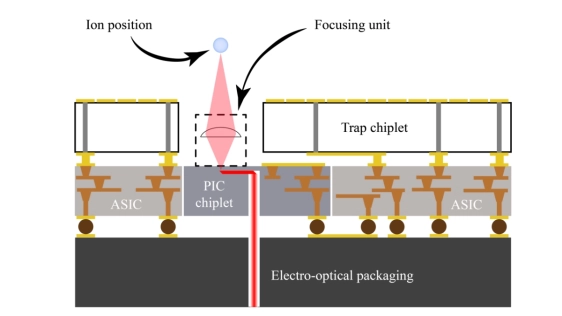
Trapped ions are among the most promising platforms for realizing a large-scale quantum information processor. Current progress focuses on integrating optical and electronic components into microfabricated ion traps to allow scaling to large numbers of ion qubits. Most available fabrication strategies for such integrated processors employ monolithic integration of all processor components and rely heavily on CMOS-compatible semiconductor fabrication technologies that are not optimized for the requirements of a trapped-ion quantum processor. In this work, we present a modular approach in which the processor modules, called chiplets, have specific functions and are fabricated separately. The individual chiplets are then combined using heterogeneous integration techniques. This strategy opens up the possibility of choosing the optimal materials and fabrication technology for each of the chiplets, with a minimum amount of fabrication limitations compared to the monolithic approach. Chiplet technology furthermore enables novel processor functionalities to be added in a cost-effective, modular fashion by adding or modifying only a subset of the chiplets. We describe the design concept of a chiplet-based trapped-ion quantum processor and demonstrate the technology with an example of an integrated individual-ion addressing system for a ten-ion crystal. The addressing system emphasizes the modularity of the chiplet approach, combining a surface ion trap manufactured on a glass substrate with a silicon substrate carrying integrated waveguides and a stack of 3D-printed micro-optics, achieving diffraction-limited focal spots at the ion positions.
To read the full article, click here
Related Chiplet
- Optical Chiplet
- Reverse Gearbox Chiplet
- FlexGen Multi-Die Smart Network-on-Chip (NoC) IP
- Ncore Multi-Die Interconnect IP
- Integrated voltage regulator (IVR) chiplet
Related Technical Papers
- Chipmunq: Fault-Tolerant Compiler for Chiplet Quantum Architectures
- Chipmunq: A Fault-Tolerant Compiler for Chiplet Quantum Architectures
- QBX: A Compiler for 2-local Qubit Hamiltonian Simulation on Quantum Chiplets
- Gemini: Mapping and Architecture Co-exploration for Large-scale DNN Chiplet Accelerators
Latest Technical Papers
- PAISF: A Partially Adaptive In-Order Selection Function for Routing in On-Chip, Inter-Chiplet, and Wafer-Scale Networks
- LASH-PAT: Deadlock-Free Adaptive Shortest-Path Routing for Inter-Chiplet Interconnects
- ThermLeT: Transformer-based Temperature Prediction for 2.5D Chiplet Architecture
- Technical Challenges for Ultra Fine Pitch Hybrid Bonding
- DT-MATCH: Defect- and Topology-Aware Chiplet Matching for Yield Optimization in Heterogeneous Integration