Chiplet-Escape: An Efficient Obstacle-Avoiding Escape Routing Method for Die-to-Die Interconnections in Chiplet-Based Designs
WEIQING JI, School of Computer and Communication Engineering, University of Science and Technology Beijing, Beijing, China
MINGYANG KOU, School of Computer and Communication Engineering, University of Science and Technology Beijing, Beijing, China
ZHIYANG CHEN, Tsinghua University, Beijing, China
JIANWANG ZHAI, Beijing University of Posts and Telecommunications, Beijing, China
NING XU, School of Information Engineering, Wuhan University of Technology, Wuhan, China
FEI LI, Empyrean Technology Co., Ltd., Beijing, China
HAILONG YAO, University of Science and Technology Beijing, Beijing, China and Key Laboratory of Advanced Materials and Devices for Post-Moore Chips, Ministry of Education, Beijing, China
Abstract
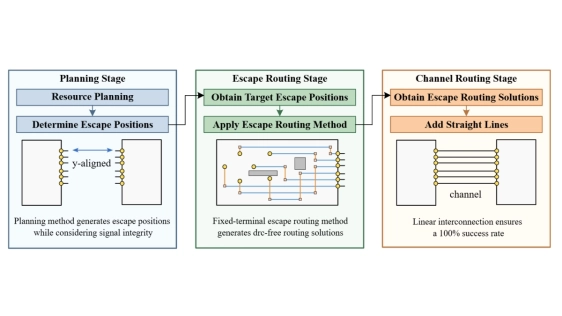
Chiplet-based designs, also known as multi-die systems, have introduced a new paradigm that enables significant integration and performance enhancement. Interconnections between different dies are crucial to the success of such designs, where escape routing is commonly employed to satisfy the net connection assignments. Traditional escape routing methods, by and large, are either based on integer linear programming (ILP) or rip-up and reroute optimization, which tend to be inefficient for chiplet-based designs due to the high-density single-layer interconnections and the presence of various obstacles. This work presents an efficient obstacle-avoiding escaping routing method specially designed for die-to-die interconnections in chiplet-based designs, called Chiplet-Escape. Chiplet-Escape divides the complex routing process into multiple sequential stages exhibiting Markov property, where each stage’s optimization only depends on the immediate previous stage’s routing configuration. Chiplet-Escape requires all nets to be moved within each stage to ensure that the routing results of all nets at this stage are determined. Thus, the routing solution for the next stage can be accurately evaluated and decided based on the existing routing results of all nets, avoiding frequent rip-up and reroute operations caused by incomplete routing perspectives in traditional sequential routing methods and improving routing efficiency. Experimental results show that Chiplet-Escape can achieve high routability and a significant 88% runtime reduction compared with a state-of-the-art (SOTA) commercial router.
To read the full article, click here
Related Chiplet
- Optical Chiplet
- Reverse Gearbox Chiplet
- FlexGen Multi-Die Smart Network-on-Chip (NoC) IP
- Ncore Multi-Die Interconnect IP
- Integrated voltage regulator (IVR) chiplet
Related Technical Papers
- Dual-Stripline Configuration for Efficient Routing in Chiplet Interconnects
- Probeless Fault Isolation Capability for 2.5D/3D Chiplet Die-to-Die Interconnect
- Advanced Chiplet Placement and Routing Optimization considering Signal Integrity
- EOTPR Fine Pitch Probing for Die-to-Die Interconnect Failure Analysis
Latest Technical Papers
- Adaptive 3D Chiplet Architecture with Hybrid Wired–Wireless Interconnect for Energy-Efficient Heterogeneous Computing
- LLM-Augmented Bayesian Optimization with Adaptive Policies for Chiplet Design Space Exploration
- Divide and conquer: Scalable performance and energy in MCM GPUs
- A Composable AI-Accelerated Iterative Solver for 3D-IC Thermal Modeling
- QBX: A Compiler for 2-local Qubit Hamiltonian Simulation on Quantum Chiplets