A PPA-Driven 3D-IC Partitioning Selection Framework with Surrogate Models
By Shang Wang 1, Shuai Liu 1, Owen Randall 1, Matthew E. Taylor 1,2
1 University of Alberta, Canada
2 Alberta Machine Intelligence Institute (Amii), Canada
Abstract
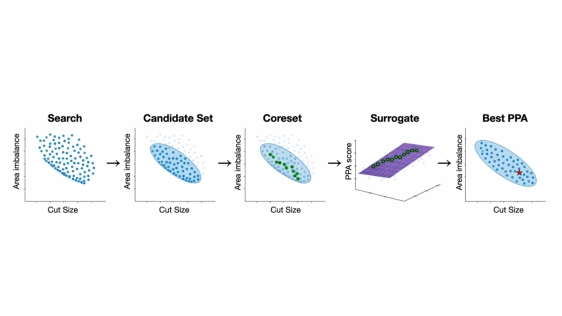
3D-IC netlist partitioning is commonly optimized using proxy objectives, while final PPA is treated as a costly evaluation rather than an optimization signal. This proxy-driven paradigm makes it difficult to reliably translate additional PPA evaluations into better PPA outcomes. To bridge this gap, we present DOPP (D-Optimal PPA-driven partitioning selection), an approach that bridges the gap between proxies and true PPA metrics. Across eight 3D-IC designs, our framework improves PPA over Open3DBench (average relative improvements of 9.99% congestion, 7.87% routed wirelength, 7.75% WNS, 21.85% TNS, and 1.18% power). Compared with exhaustive evaluation over the full candidate set, DOPP achieves comparable best-found PPA while evaluating only a small fraction of candidates, sub stantially reducing evaluation cost. By parallelizing evaluations, our method delivers these gains while maintaining wall-clock runtime comparable to traditional baselines.
Index Terms — 3D IC Partitioning, Linear regression, D-optimal design, Power Performance Area (PPA)
To read the full article, click here
Related Chiplet
- Optical Chiplet
- Reverse Gearbox Chiplet
- FlexGen Multi-Die Smart Network-on-Chip (NoC) IP
- Ncore Multi-Die Interconnect IP
- Integrated voltage regulator (IVR) chiplet
Related Technical Papers
- WarPGNN: A Parametric Thermal Warpage Analysis Framework with Physics-aware Graph Neural Network
- A Heterogeneous Chiplet Architecture for Accelerating End-to-End Transformer Models
- The 3D-IC Multiphysics Challenge Dictates A Shift-Left Strategy
- Muchisim: A Simulation Framework for Design Exploration of Multi-Chip Manycore Systems
Latest Technical Papers
- Adaptive 3D Chiplet Architecture with Hybrid Wired–Wireless Interconnect for Energy-Efficient Heterogeneous Computing
- LLM-Augmented Bayesian Optimization with Adaptive Policies for Chiplet Design Space Exploration
- Divide and conquer: Scalable performance and energy in MCM GPUs
- A Composable AI-Accelerated Iterative Solver for 3D-IC Thermal Modeling
- QBX: A Compiler for 2-local Qubit Hamiltonian Simulation on Quantum Chiplets