When Every Chiplet Passes, Who Fixes the Package?

Why multi-vendor chiplet integration needs shared failure evidence, not just shared interface standards
The Promise of Modularity Meets an Unexpected Failure
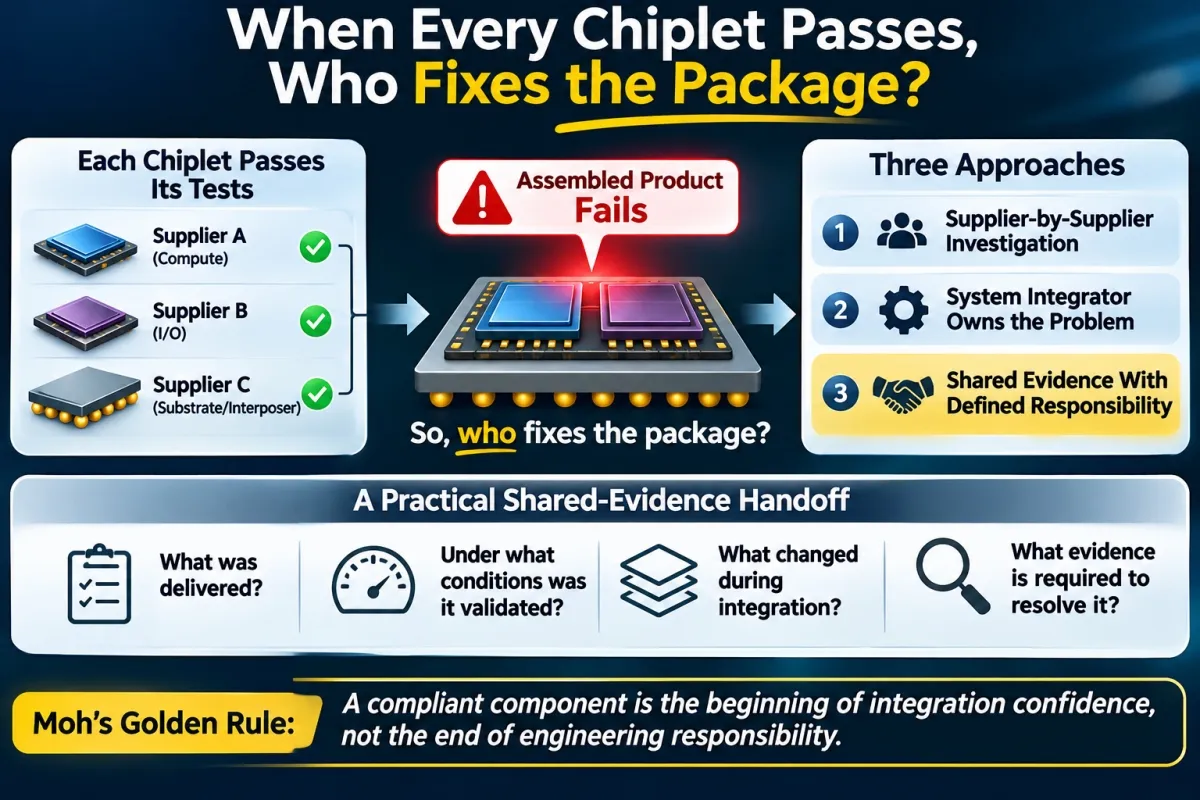
Imagine a heterogeneous AI package assembled from three suppliers.
Supplier A delivers a compute chiplet that passes wafer-level testing. Supplier B delivers an I/O chiplet that meets its electrical interface specifications. Supplier C provides an interposer or substrate that satisfies its dimensional and manufacturing requirements.
Assembly is completed. The individual components are compliant.
Yet the finished package experiences intermittent high-speed link failures under elevated-temperature operation.
Each supplier presents its test results. Each component passed.
So who fixes the package?
This is one of the most consequential challenges facing the emerging multi-vendor chiplet ecosystem.
Chiplet modularity promises greater design flexibility, reusable silicon, faster product development, and access to specialized technologies. But the economic benefits depend on more than the ability to connect independently designed dies.
They depend on how effectively the ecosystem can resolve failures that emerge only after those dies become one physical product.
The opportunity is significant: a supply chain that can diagnose, correct, and qualify multi-vendor integration problems without repeatedly redesigning the complete system.
Achieving that capability requires more than interoperability. It requires an engineering process for shared evidence.
Three Ways to Manage a Multi-Supplier Failure
There are three practical approaches, each with different implications for engineering responsibility, development time, and manufacturing scalability.
1. Supplier-by-Supplier Investigation
The traditional approach is to return each component or interface concern to its respective supplier.
The compute supplier investigates its silicon. The I/O supplier reviews its transmitter and receiver. The substrate supplier examines materials and geometry. The assembly partner evaluates bonding and process records.
This approach works when a failure is clearly isolated to a particular component.
But many heterogeneous-package problems are not isolated.
An intermittent link failure may depend on a combination of transmitter behavior, receiver margin, interconnect impedance, power noise, package deformation, and operating temperature.
Each supplier may demonstrate compliance against its own test conditions while the integrated product remains outside its required operating margin.
The limitation is not necessarily poor supplier performance.
It is that the failure exists across the boundaries used to divide engineering responsibility.
2. System Integrator Owns the Complete Problem
A second approach assigns system-level failure resolution to the product integrator.
The integrator maintains the complete electrical, thermal, mechanical, and manufacturing picture, coordinates experiments, and determines which subsystem requires correction.
This creates clearer accountability and can accelerate investigations when the integrator has sufficient access to the relevant design models and production records.
However, the approach becomes difficult when critical information remains proprietary to individual suppliers.
A product team may have final-package test results without access to the die-level parameters, characterization boundaries, or manufacturing histories needed to distinguish competing failure mechanisms.
Owning the problem does not automatically mean possessing the evidence required to solve it.
3. Shared Evidence With Defined Engineering Responsibility
A third approach combines system-level ownership with structured evidence contributions from each supplier.
The integrator retains responsibility for overall product acceptance and investigation coordination. Suppliers remain responsible for their respective components, processes, and applicable corrective actions.
But before integration, the parties define what information will be available when a cross-boundary failure occurs.
This may include relevant electrical operating margins, interface characterization conditions, package geometry, metrology, process histories, environmental test results, and traceability to manufacturing configurations.
Not every supplier needs to disclose proprietary design details.
The objective is to establish enough comparable evidence to investigate whether a failure originates within a component, at a manufactured interface, or through the interaction of multiple physical conditions.
The important distinction is between assigning responsibility and establishing causality.
Responsibility determines who must act. Engineering evidence determines what action is justified.
The Failure May Not Belong to One Component
Consider the intermittent electrical-link failure.
At nominal temperature, both chiplets satisfy their interface requirements. Initial assembly inspection reports acceptable interconnect geometry.
During elevated-temperature operation, the link begins to exhibit an increased error rate.
Several explanations are possible:
- The transmitter or receiver has insufficient margin under the relevant operating conditions.
- Package interconnect geometry introduces greater channel loss or impedance discontinuity than expected.
- Thermal-mechanical deformation changes interconnect stress or electrical characteristics.
- Power-distribution noise and temperature-dependent circuit behavior interact to reduce the available link margin.
The presence of an error does not identify which mechanism is responsible.
Nor does correlation with temperature prove that package deformation is the cause.
An effective investigation must connect the failure to a defined physical state and operating condition.
The team may begin by comparing electrical measurements at different temperatures, examining power-integrity behavior, correlating failures with manufacturing lots, and reviewing relevant package metrology.
If the evidence supports a possible mechanical contribution, thermal-mechanical analysis and targeted experiments can test whether deformation affects the electrical interface.
The objective is to distinguish plausible explanations before changing a component, manufacturing process, or architecture.
This is where shared evidence becomes valuable.
Without it, the investigation can become a sequence of disconnected supplier reports. With it, engineering teams can evaluate competing mechanisms against the same observed failure.
A Practical Evidence Handoff
A multi-vendor chiplet ecosystem needs a stronger technical handoff than a datasheet and a pass/fail certificate.
I would organize the handoff around four questions.
What was delivered?
Identify the chiplet revision, applicable interface specification, tested configuration, manufacturing traceability, and relevant acceptance results.
Under what conditions was it validated?
Define the electrical, thermal, power, mechanical, and test conditions supporting the reported performance. A result is meaningful only within the conditions under which it was established.
What changed during integration?
Connect package assembly records, interconnect geometry, manufacturing variation, and post-assembly functional measurements with the original component assumptions.
What evidence is required to resolve a discrepancy?
Agree in advance on test access, diagnostic information, responsible engineering contacts, escalation paths, and the criteria for validating corrective action.
This does not require every organization to share unrestricted proprietary information.
It requires defining the minimum evidence necessary to support integration, investigation, and qualification.
That distinction becomes increasingly important as chiplet ecosystems move from closely coordinated internal designs toward broader commercial interoperability.
Standards Enable Connectivity. Engineering Must Establish Closure.
Industry standards are essential to scaling chiplet adoption.
UCIe provides a common foundation for die-to-die connectivity and has expanded its support for testability, manageability, and system-level integration.
These capabilities can make cross-supplier diagnosis more practical.
But standardized connectivity does not independently demonstrate that every assembled package will satisfy its electrical, thermal, mechanical, manufacturing, and reliability requirements.
Nor does a compliant interface automatically determine the physical mechanism responsible for a product-level failure.
Engineering closure requires a connected sequence:
Component evidence → Assembled-interface evidence → Product-level failure characterization → Validated mechanism → Corrective action → Reverification
The final step matters.
A supplier's corrective action is not complete simply because a local test improves. The revised component, interface, or manufacturing condition must be evaluated against the affected system requirements.
Where the change influences qualified product configurations, appropriate regression testing and requalification may be necessary.
From Supplier Compliance to Ecosystem Confidence
The long-term opportunity for chiplet marketplaces is larger than cataloging compatible components.
A mature ecosystem can help customers assess integration readiness, understand the limits of available component evidence, and establish expectations for the engineering support needed across the product lifecycle.
That capability could reduce uncertainty in supplier selection, make integration programs more predictable, and improve the industry's ability to scale heterogeneous products across different manufacturing partners.
It also creates an important distinction between two types of supplier readiness.
A supplier may be ready to ship a compliant chiplet.
But is the supplier ready to support the engineering investigation when that chiplet becomes part of a product that does not meet its requirements?
Those are different questions.
And for an open chiplet ecosystem, both matter.
Moh's Golden Rule
A compliant component is the beginning of integration confidence, not the end of engineering responsibility.
The future of chiplet modularity will depend not only on whether components can connect, but on whether the organizations behind them can establish what went wrong, determine what must change, and verify that the complete product now works.
The true test of interoperability begins when something fails.
© 2026 Moh Kolbehdari
Related Chiplet
- Optical Chiplet
- Reverse Gearbox Chiplet
- FlexGen Multi-Die Smart Network-on-Chip (NoC) IP
- Ncore Multi-Die Interconnect IP
- Integrated voltage regulator (IVR) chiplet
Related Blogs
- Chiplet Realization Beyond the Package: Why the Next AI Bottleneck Moves to the Interposer-to-PCB Boundary
- When EMC Shielding Must Bend With the Package
- When the Package Becomes an Electrical Design Variable
- The Chiplet Is Not the System: Partitioning, Placement, and Package Geometry in Heterogeneous Integration