3D-ICE 4.0: Accurate and efficient thermal modeling for 2.5D/3D heterogeneous chiplet systems
By Kai Zhu *, Darong Huang *, Luis Costero º, David Atienza *
* Embedded Systems Laboratory, EPFL. Switzerland
º Universidad Complutense de Madrid. Spain
Abstract
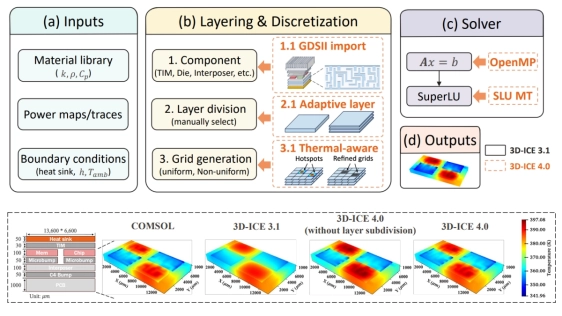
The increasing power densities and intricate heat dissipation paths in advanced 2.5D/3D chiplet systems necessitate thermal modeling frameworks that deliver detailed thermal maps with high computational efficiency. Traditional compact thermal models (CTMs) often struggle to scale with the complexity and heterogeneity of modern architectures. This work introduces 3DICE 4.0* , designed for heterogeneous chip-based systems. Key innovations include: (i) preservation of material heterogeneity and anisotropy directly from industrial layouts, integrated with OpenMP and SuperLU MT-based parallel solvers for scalable performance, (ii) adaptive vertical layer partitioning to accurately model vertical heat conduction, and (iii) temperature-aware nonuniform grid generation. The results with different benchmarks demonstrate that 3D-ICE 4.0 achieves speedups ranging from 3.61×–6.46× over state-of-the-art tools, while reducing grid complexity by more than 23.3% without compromising accuracy. Compared to the commercial software COMSOL, 3D-ICE 4.0 effectively captures both lateral and vertical heat flows, validating its precision and robustness. These advances demonstrate that 3DICE 4.0 is an efficient solution for thermal modeling in emerging heterogeneous 2.5D/3D integrated systems.
Index Terms—Thermal modeling, 2.5D/3D integration, chiplet systems, adaptive algorithm, non-uniform, parallel acceleration
To read the full article, click here
Related Chiplet
- DPIQ Tx PICs
- IMDD Tx PICs
- Near-Packaged Optics (NPO) Chiplet Solution
- High Performance Droplet
- Interconnect Chiplet
Related Technical Papers
- ATSim: A Fast and Accurate Simulation Framework for 2.5D/3D Chiplet Thermal Design Optimization
- Fast and Accurate Jitter Modeling for Statistical BER Analysis for Chiplet Interconnect and Beyond
- MFIT : Multi-FIdelity Thermal Modeling for 2.5D and 3D Multi-Chiplet Architectures
- Fault Modeling, Testing, and Repair for Chiplet Interconnects
Latest Technical Papers
- Spatiotemporal thermal characterization for 3D stacked chiplet systems based on transient thermal simulation
- Interconnect-Aware Logic Resynthesis for Multi-Die FPGAs
- Scope: A Scalable Merged Pipeline Framework for Multi-Chip-Module NN Accelerators
- Scaling Routers with In-Package Optics and High-Bandwidth Memories
- TDPNavigator-Placer: Thermal- and Wirelength-Aware Chiplet Placement in 2.5D Systems Through Multi-Agent Reinforcement Learning