A Comprehensive Design Framework for Vertical Power Delivery in High-Performance Computing
By Sriharini Krishnakumar 1, Yaroslav Popryho 1, Mingeun Choi 2, Ramin Rahimzadeh Khorasani 3, Madhavan Swaminathan 3, Satish Kumar 2, Inna Partin-Vaisband 1
1 Department of Electrical and Computer Engineering, University of Illinois Chicago, Chicago, IL 60607 USA
2 George W. Woodruff School of Mechanical Engineering, Georgia Institute of Technology, Atlanta, GA 30332, USA
3 School of Electrical Engineering and Computer Science, Pennsylvania State University, State College, PA 16801, USA
Abstract
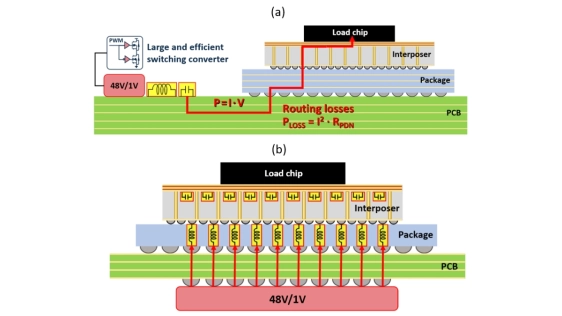
Power delivery -- including high-to-low voltage conversion, complex power distribution across heterogeneously integrated chiplets, and efficient interconnect allocation -- remains a critical bottleneck in high-performance computing (HPC) systems. Existing vertical power delivery (VPD) solutions are estimated to achieve less than 70% system-wide end-to-end power delivery efficiency, defined from platform input power to delivered on-chip load power, with substantial energy lost as heat before reaching on-chip point-of-loads (POLs). In the absence of systematic design methodologies, evaluating power quality, exploring architectural alternatives, and optimizing performance rely on computationally prohibitive simulations, resulting in suboptimal designs. This paper introduces an end-to-end scalable power delivery framework for HPC systems, including distributed VPD (DVPD) architecture, DVPD design optimization methodology, and analytical models. The framework leverages substrate-embedded GaN power switches together with arrays of unit inductors and capacitors tailored for HPC applications. Multi-stage power conversion schemes (48V-to-1V, 48V-to-24V-to-1V, and 48V-to-12V-to-1V) are explored, with system-wide voltage drops and power losses evaluated under steady-state conditions. Design specifications for passive and active devices are formulated to meet next-generation efficiency targets. For the 48V-to-1V case, the proposed DVPD approach achieves 84\% system-wide efficiency while occupying 54\% of the area beneath the load system, with efficiency increasing to 87.6% at 75% area utilization across a 1--50~kW load range. Furthermore, steady-state voltage drops peak at 2.7% and transient drops at 9\% (without decoupling capacitors), demonstrating the viability of DVPD for future wafer-scale HPC platforms.
Index Terms — distributed vertical power delivery, 48V/1V, 12V/1V, heterogeneous integration roadmap (HIR), high current density, 3D, 2.5D, high performance computing (HPC).
To read the full article, click here
Related Chiplet
- Optical Chiplet
- Reverse Gearbox Chiplet
- FlexGen Multi-Die Smart Network-on-Chip (NoC) IP
- Ncore Multi-Die Interconnect IP
- Integrated voltage regulator (IVR) chiplet
Related Technical Papers
- Co-Optimization of Power Delivery Network Design for 3-D Heterogeneous Integration of RRAM-Based Compute In-Memory Accelerators
- Toward Multi-kW Power Delivery Methodologies for Advanced 3D Heterogeneous Integration
- Thermal Implications of Non-Uniform Power in BSPDN-Enabled 2.5D/3D Chiplet-based Systems-in-Package using Nanosheet Technology
- 3D Stacked HBM and Compute Accelerators for LLM: Optimizing Thermal Management and Power Delivery Efficiency
Latest Technical Papers
- Adaptive 3D Chiplet Architecture with Hybrid Wired–Wireless Interconnect for Energy-Efficient Heterogeneous Computing
- LLM-Augmented Bayesian Optimization with Adaptive Policies for Chiplet Design Space Exploration
- Divide and conquer: Scalable performance and energy in MCM GPUs
- A Composable AI-Accelerated Iterative Solver for 3D-IC Thermal Modeling
- QBX: A Compiler for 2-local Qubit Hamiltonian Simulation on Quantum Chiplets