A Time-Encoded Analog Photonic Interposer for Energy-Efficient Integration of Analog Vision Sensors and Analog Accelerators
By Subhradip Chakraborty 1 , Zihan Yin 1, Xuming Chen 2, Chengwei Zhou 2, Gourav Datta 2, and Akhilesh Jaiswal 1
1 University of Wisconsin–Madison, Madison, WI, USA
2 Case Western Reserve University, Madison, WI, USA
Abstract
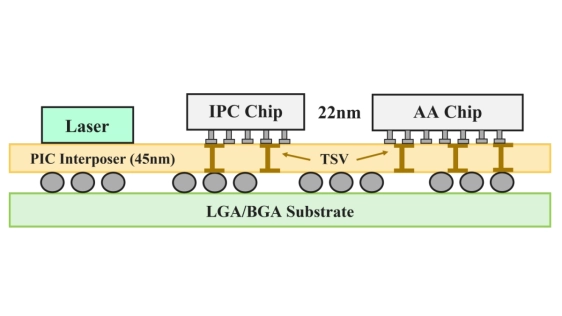
This work introduces a time-encoded analog photonic interposer that enables long-distance, high-fidelity transport of analog signals between spatially separated chiplets. Unlike prior silicon-photonic links limited to digital data, the interposer preserves analog information by converting amplitudes into timing intervals using an analog-to-time converter (ATC), transmitting them over a wavelength-division-multiplexed photonic link, and reconstructing values at the receiver without an explicit high-precision ADC/DAC data-converter pipeline. The link instead embeds an implicit 6-bit time-domain quantization and uses a single wavelength per processing element independent of bit precision. Evaluated in a fully analog vision pipeline with an in-pixel computing (IPC) sensor, it achieves a 2.04x energy--delay product (EDP) improvement over an 8-bit digital electrical baseline on the 560x560 Visual Wake Words dataset, with the advantage widening with link length even against a precision-matched 6-bit baseline. The pipeline holds 89.87% and 86.15% accuracy on ResNet18 and MobileNetV2 for VWW and generalizes across CIFAR-10 and ModelNet40 within 2% of the digital baseline.
Keywords: 2.5D Integration, Analog Photonic Interposer, Analog Accelerator, In-pixel Computing, Time-domain Computing
To read the full article, click here
Related Chiplet
- Optical Chiplet
- Reverse Gearbox Chiplet
- FlexGen Multi-Die Smart Network-on-Chip (NoC) IP
- Ncore Multi-Die Interconnect IP
- Integrated voltage regulator (IVR) chiplet
Related Technical Papers
- Photonic Chiplet Interconnection via 3D-Nanoprinted Interposer
- Hardware Trojan Threats to Multi-Chiplet Photonic Neural Network Accelerators
- Gemini: Mapping and Architecture Co-exploration for Large-scale DNN Chiplet Accelerators
- SCAR: Scheduling Multi-Model AI Workloads on Heterogeneous Multi-Chiplet Module Accelerators
Latest Technical Papers
- Adaptive 3D Chiplet Architecture with Hybrid Wired–Wireless Interconnect for Energy-Efficient Heterogeneous Computing
- LLM-Augmented Bayesian Optimization with Adaptive Policies for Chiplet Design Space Exploration
- Divide and conquer: Scalable performance and energy in MCM GPUs
- A Composable AI-Accelerated Iterative Solver for 3D-IC Thermal Modeling
- QBX: A Compiler for 2-local Qubit Hamiltonian Simulation on Quantum Chiplets