Hardware Trojan Threats to Multi-Chiplet Photonic Neural Network Accelerators
By Sudeep Pasricha
Department of Electrical and Computer Engineering, Colorado State University
Abstract
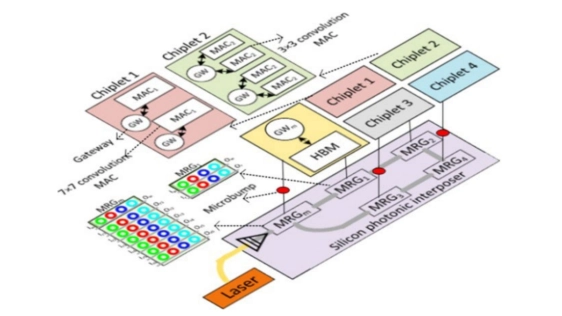
Multi-chiplet photonic neural network accelerators (MCPNAs) combine photonic computation, photonic communica-tion, and heterogeneous chiplet integration to enable scalable and energy-efficient AI acceleration. However, their distributed archi-tecture and reliance on third-party chiplets introduce significant hardware security risks. This paper examines Hardware Trojan (HT) threats to MCPNAs across three dimensions: confidentiality, integrity, and availability.
Index Terms—Multi-chiplet systems, silicon photonics, network-on-interposer, hardware security, AI acceleration.
To read the full article, click here
Related Chiplet
- Optical Chiplet
- Reverse Gearbox Chiplet
- FlexGen Multi-Die Smart Network-on-Chip (NoC) IP
- Ncore Multi-Die Interconnect IP
- Integrated voltage regulator (IVR) chiplet
Related Technical Papers
- Beacon: LLM Multi-Agent Driven Hardware Design Space Exploration for Heterogeneous Multi-Chiplet Deep Learning Accelerators
- SCAR: Scheduling Multi-Model AI Workloads on Heterogeneous Multi-Chiplet Module Accelerators
- Communication Characterization of AI Workloads for Large-scale Multi-chiplet Accelerators
- Spiking Transformer Hardware Accelerators in 3D Integration
Latest Technical Papers
- Adaptive 3D Chiplet Architecture with Hybrid Wired–Wireless Interconnect for Energy-Efficient Heterogeneous Computing
- LLM-Augmented Bayesian Optimization with Adaptive Policies for Chiplet Design Space Exploration
- Divide and conquer: Scalable performance and energy in MCM GPUs
- A Composable AI-Accelerated Iterative Solver for 3D-IC Thermal Modeling
- QBX: A Compiler for 2-local Qubit Hamiltonian Simulation on Quantum Chiplets