Mozart: A Chiplet Ecosystem-Accelerator Codesign Framework for Composable Bespoke Application Specific Integrated Circuits
By Haoran Jin, Jirong Yang, Yunpeng Liu, Barry Lyu, Kangqi Zhang, Nathaniel Bleier
University of Michigan, USA
Abstract
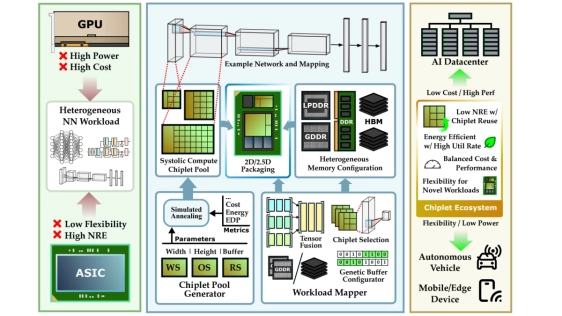
Modern AI acceleration faces a fundamental challenge: conventional assumptions about memory requirements, batching effectiveness, and latency-throughput tradeoffs are systemwide generalizations that ignore the heterogeneous computational patterns of individual neural network operators. However, going towards network-level customization and operator-level heterogeneity incur substantial Non-Recurring Engineering (NRE) costs. While chiplet-based approaches have been proposed to amortize NRE costs, reuse opportunities remain limited without carefully identifying which chiplets are truly necessary. This paper introduces Mozart, a chiplet ecosystem and accelerator codesign framework that systematically constructs low cost bespoke application-specific integrated circuits (BASICs). BASICs leverage operator-level disaggregation to explore chiplet and memory heterogeneity, tensor fusion, and tensor parallelism, with place-and-route validation ensuring physical implementability. The framework also enables constraint-aware system-level optimization across deployment contexts ranging from datacenter inference serving to edge computing in autonomous vehicles. The evaluation confirms that with just 8 strategically selected chiplets, Mozart-generated composite BASICs achieve 43.5%, 25.4%, 67.7%, and 78.8% reductions in energy, energy-cost product, energy-delay product (EDP), and energy-delay-cost product compared to traditional homogeneous accelerators. For datacenter LLM serving, Mozart achieves 15-19% energy reduction and 35-39% energy-cost improvement. In speculative decoding, Mozart delivers throughput improvements of 24.6-58.6% while reducing energy consumption by 38.6-45.6%. For autonomous vehicle perception, Mozart reduces energy-cost by 25.54% and energy by 10.53% under real-time constraints.
To read the full article, click here
Related Chiplet
- Optical Chiplet
- Reverse Gearbox Chiplet
- FlexGen Multi-Die Smart Network-on-Chip (NoC) IP
- Ncore Multi-Die Interconnect IP
- Integrated voltage regulator (IVR) chiplet
Related Technical Papers
- CLIPGen: A Chiplet Link IP Modeling and Generation Framework for 2.5D Architecture Exploration
- HYDRA: A Heterogeneous Chiplet DSE Framework for Serving Dynamic Hybrid LLM Workloads
- Fengshui: Demystifying Chiplet Ecosystem and Bespoke Neural Network Accelerator Codesign
- Automakers And Industry Need Specific, Extremely Robust, Heterogeneously Integrated Chiplet Solutions
Latest Technical Papers
- Adaptive 3D Chiplet Architecture with Hybrid Wired–Wireless Interconnect for Energy-Efficient Heterogeneous Computing
- LLM-Augmented Bayesian Optimization with Adaptive Policies for Chiplet Design Space Exploration
- Divide and conquer: Scalable performance and energy in MCM GPUs
- A Composable AI-Accelerated Iterative Solver for 3D-IC Thermal Modeling
- QBX: A Compiler for 2-local Qubit Hamiltonian Simulation on Quantum Chiplets