Electrothermal co-optimization of 2.5D power distribution network with TTSV cooling
By Yang Wang, Changle Zhi, Gang Dong, Daihang Liu, Deguang Yang & Zhangming Zhu
Xidian University, China
Abstract
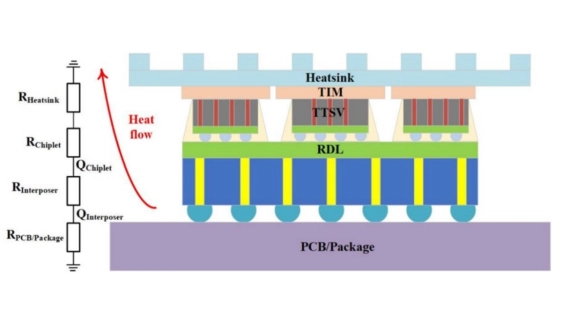
Thermal and power integrity management remains a fundamental challenge in 2.5-dimensional (2.5D) integrated microsystem design. This paper proposes an electrothermal co-optimization design methodology for a 2.5D power distribution network with thermal through silicon via (TTSV) cooling. A hybrid metaheuristic optimization algorithm is presented to optimize the multi-objective function in terms of both the electrothermal properties and manufacturing cost. The proposed approach achieves an optimal solution (minimum fitness value = 310.3) for TTSV scaling and chiplet placement, albeit with increased computational complexity. Compared to the finite element simulation results, the average absolute errors of the impedance and temperature values obtained from the optimization are 3.97 and 0.35, respectively. The proposed method is effective in enhancing thermal management, satisfying power and signal integrity requirements, and minimizing manufacturing costs.
To read the full article, click here
Related Chiplet
- Optical Chiplet
- Reverse Gearbox Chiplet
- FlexGen Multi-Die Smart Network-on-Chip (NoC) IP
- Ncore Multi-Die Interconnect IP
- Integrated voltage regulator (IVR) chiplet
Related Technical Papers
- Co-Optimization of Power Delivery Network Design for 3-D Heterogeneous Integration of RRAM-Based Compute In-Memory Accelerators
- Inter-chip Clock Network Synthesis on Passive Interposer of 2.5D Chiplet Considering Transmission Line Effect
- Thermo-mechanical co-design of 2.5D flip-chip packages with silicon and glass interposers via finite element analysis and machine learning
- Thermo-mechanical reliability evaluation and comparative fatigue assessment of 2.5D chiplet packages with viscoelastic C4 underfill
Latest Technical Papers
- Adaptive 3D Chiplet Architecture with Hybrid Wired–Wireless Interconnect for Energy-Efficient Heterogeneous Computing
- LLM-Augmented Bayesian Optimization with Adaptive Policies for Chiplet Design Space Exploration
- Divide and conquer: Scalable performance and energy in MCM GPUs
- A Composable AI-Accelerated Iterative Solver for 3D-IC Thermal Modeling
- QBX: A Compiler for 2-local Qubit Hamiltonian Simulation on Quantum Chiplets