Chiplet-Based Techniques for Scalable and Memory-Aware Multiscalar Multiplication on Hardware Platforms
By Florian Hirner, Florian Krieger and Sujoy Sinha Roy
Institute of Information Security, Graz University of Technology, Graz 8010, Austria
Abstract
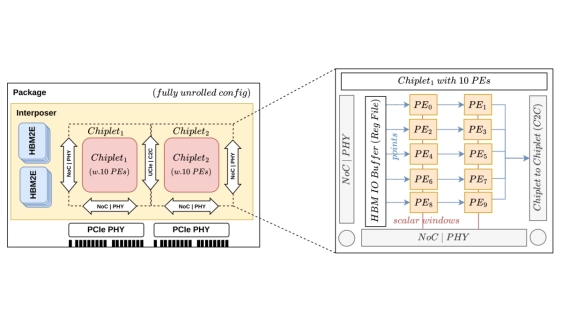
This article presents a high-performance architecture for accelerating multiscalar multiplication (MSM) on ASIC platforms, targeting cryptographic applications with high throughput and scalability demands. Current MSM accelerators on FPGA and ASIC platforms typically focus on designing efficient processing elements (PEs) to perform resource-intensive elliptic curve point operations, which require a high number of 384-bit modular multipliers. Our approach diverges from existing works by adopting a chiplet-based design, which optimally balances area, power consumption, and computational throughput. By analyzing memory requirements across window sizes, we determine an optimal mixed configuration of 12- and 13-bit windows, which allows efficient integration of multiple PEs per chiplet. Considering the single-PE case, our design achieves a 1.37x speedup and a 1.3x area reduction over prior works. Moreover, our multi-PE chiplet design outperforms monolithic designs by 2.2x in area–time product while allowing lower production costs and higher yield.
Index Terms — Hardware acceleration, multiscalar multiplication (MSM), parallel computing, scalable chiplet architecture, zero-knowledge proof (ZKP).
To read the full article, click here
Related Chiplet
- Optical Chiplet
- Reverse Gearbox Chiplet
- FlexGen Multi-Die Smart Network-on-Chip (NoC) IP
- Ncore Multi-Die Interconnect IP
- Integrated voltage regulator (IVR) chiplet
Related Technical Papers
- Chiplet-Based Techniques for Scalable and Memory-Aware Multi-Scalar Multiplication
- On hardware security and trust for chiplet-based 2.5D and 3D ICs: Challenges and Innovations
- Taming the Tail: NoI Topology Synthesis for Mixed DL Workloads on Chiplet-Based Accelerators
- CHIPSIM: A Co-Simulation Framework for Deep Learning on Chiplet-Based Systems
Latest Technical Papers
- LLM-Augmented Bayesian Optimization with Adaptive Policies for Chiplet Design Space Exploration
- Divide and conquer: Scalable performance and energy in MCM GPUs
- A Composable AI-Accelerated Iterative Solver for 3D-IC Thermal Modeling
- QBX: A Compiler for 2-local Qubit Hamiltonian Simulation on Quantum Chiplets
- U-Can-Inject-Errors (UCIe): A Protocol-Aware Hardware Trojan for FPGA Chiplet Links