AuxiliarySRAM: Exploring Elastic On-Chip Memory in 2.5D Chiplet Systems Design
By Zichao Ling, Lin Li, Yi Huang, Yixin Xuan, Jianwang Zhai, Kang Zhao
Beijing University of Posts and Telecommunications, China
Abstract
The “Memory Wall” dilemma remains a critical challenge in modern computing systems. While latency-sensitive applications increasingly rely on costly on-chip SRAM to meet performance requirements, SRAM scaling faces bottleneck. Currently, Chiplet-based techniques present a promising solution to this challenge by enabling optimized trade-offs between latency, capacity, and cost.
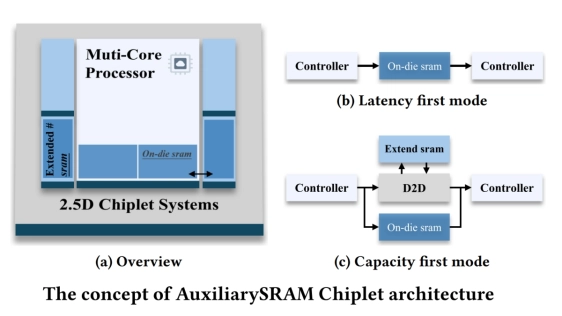
This paper introduces AuxiliarySRAM, a design methodology that decouples SRAM resources into on-die and extended chiplets, enabling elastic capacity-latency scaling. Key contributions include: (1) a lightweight network-on-chip (NoC) with simplified crossbars, dual local ports, and address prediction to reduce average latency by 49.29% and boost bandwidth by 79.35%; (2) a evaluation framework integrated with Bayesian optimization (BO) to resolve Pareto-optimal on/off-die capacity ratios, accelerated by pruning strategies (1.93× speedup); and (3) system-level evaluation provides Pareto frontier-based design guidelines and demonstrates its cost-saving advantages.
Keywords:
Memory Architecture, Chiplet System, Lightweight Network on Chip, Design Space Exploration
To read the full article, click here
Related Chiplet
- Optical Chiplet
- Reverse Gearbox Chiplet
- FlexGen Multi-Die Smart Network-on-Chip (NoC) IP
- Ncore Multi-Die Interconnect IP
- Integrated voltage regulator (IVR) chiplet
Related Technical Papers
- TDPNavigator-Placer: Thermal- and Wirelength-Aware Chiplet Placement in 2.5D Systems Through Multi-Agent Reinforcement Learning
- Multi-Chiplet Marvels: Exploring Chip-Centric Thermal Analysis
- Signal Integrity Challenges in Chiplet-Based Designs: Addressing Performance and Security
- DISTIL: A Distributed Spiking Neural Network Accelerator on 2.5D Chiplet Systems
Latest Technical Papers
- Adaptive 3D Chiplet Architecture with Hybrid Wired–Wireless Interconnect for Energy-Efficient Heterogeneous Computing
- LLM-Augmented Bayesian Optimization with Adaptive Policies for Chiplet Design Space Exploration
- Divide and conquer: Scalable performance and energy in MCM GPUs
- A Composable AI-Accelerated Iterative Solver for 3D-IC Thermal Modeling
- QBX: A Compiler for 2-local Qubit Hamiltonian Simulation on Quantum Chiplets