Chiplets and Dielets: Coexisting Technologies in Heterogeneous Integration

As heterogeneous integration becomes more specialized, chiplets and dielets can serve different but complementary roles in building the system.
The semiconductor industry has embraced the chiplet as an important architectural and integration technology.
Instead of forcing every major function into one increasingly large monolithic SoC, designers can partition functionality across multiple dies, select appropriate process technologies for different functions, and reconnect those dies through high-performance die-to-die interfaces and advanced packaging.
Alongside the chiplet, another concept has existed in heterogeneous-integration research and IEEE vocabulary for years:
Dielet.
Chiplet and dielet have often been used interchangeably. That is understandable because both involve integrating separately manufactured dies into a larger system.
But heterogeneous integration is changing.
Systems are becoming more functionally specialized. The number and diversity of dies that can participate in an integrated system are increasing. Communication and interconnection are becoming more important. And functions that once existed only as blocks inside a larger SoC can increasingly be considered at different levels of physical implementation.
Under these conditions, treating chiplet and dielet as exactly the same technology concept may hide a useful distinction.
The distinction is not simply large versus small.
It is primarily about functional role, integration intent, specialization, and system granularity.
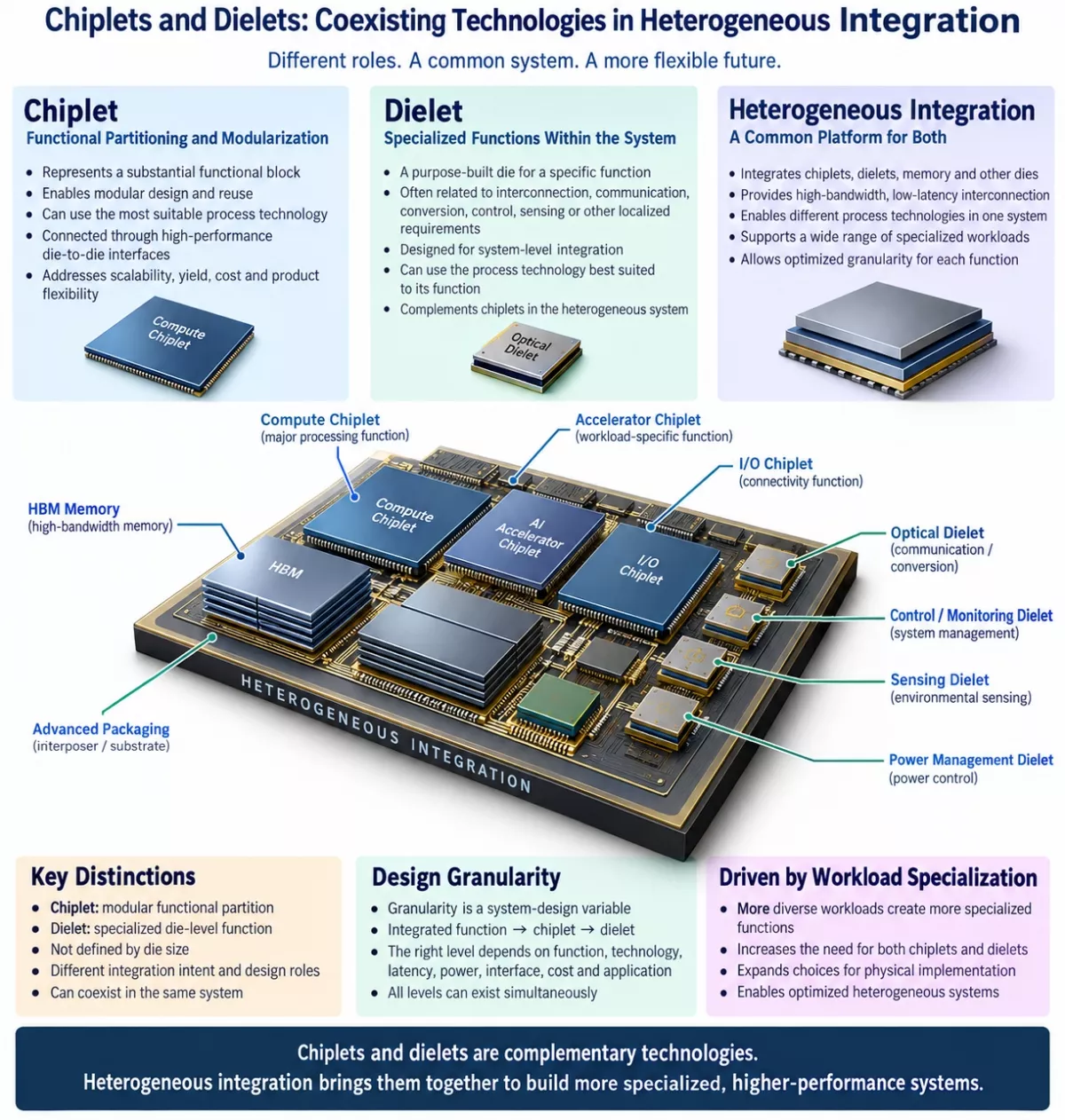
- Chiplets provide modularization of substantial system functionality.
- Dielets provide specialized die-level functions within the heterogeneous system, particularly where interconnection, communication, conversion, control, or other localized functions benefit from dedicated physical implementation.
These are not competing directions.
Chiplets and dielets can coexist within the same heterogeneous system.
Chiplets: Functional Partitioning and Modularization
The rise of chiplets addresses a fundamental semiconductor challenge.
For decades, greater functionality was integrated into increasingly complex monolithic SoCs. CPUs, GPUs, accelerators, cache, I/O, memory interfaces, security, media processing, and other functions could reside together on one die.
That remains extremely powerful.
But as systems become larger and more complex, not every function necessarily benefits from the same process technology. Large leading-edge dies also encounter increasing challenges in cost, yield, reticle constraints, design complexity, IP reuse, and product scalability.
Chiplets provide another path.
Major functions can be partitioned into modular dies and interconnected through advanced packaging and die-to-die communication.
Conceptually:
MONOLITHIC SoC
↓
FUNCTIONAL PARTITIONING
↓
COMPUTE + I/O + CACHE + ACCELERATOR CHIPLETS
↓
DIE-TO-DIE INTERCONNECTION
↓
INTEGRATED SYSTEM
A compute chiplet can provide a substantial processing function.
An I/O chiplet can separate connectivity from leading-edge compute.
An accelerator chiplet can provide a reusable workload-specific function.
Different chiplets can also use process technologies better suited to their individual requirements.
A chiplet does not have to originate by literally dividing an existing monolithic SoC. It can be designed as a chiplet from the beginning.
The important characteristic is its architectural modularity.
A chiplet represents a substantial functional building block intended to operate with other functional elements as part of a larger system.
This combination of partitioning, modularity, reuse, and high-performance interconnection is why chiplets have gained such strong industry recognition.
Dielets: Specialized Functions Within the Physical System
Now consider the heterogeneous system from another perspective.
The system does not contain only major compute, accelerator, and I/O functions.
It also requires increasingly specialized functions associated with communication, interconnection, conversion, control, monitoring, sensing, synchronization, analog operation, security, power management, and other localized requirements.
Some of these functions may benefit from being implemented as their own purpose-built dies.
This is where the concept of the dielet becomes particularly useful.
A dielet does not necessarily represent a major functional partition of a large SoC.
Instead, it can be a specialized physical die designed from the beginning to perform a particular function within the larger heterogeneous system.
Consider optical communication.
A small electro-optical die positioned near a compute or I/O function may perform electrical-to-optical or optical-to-electrical conversion. Its existence is not necessarily the result of partitioning a large compute SoC.
Its function exists because the system requires communication at that physical interface.
A similar argument can apply to specialized electrical interfaces, analog functions, clocking, monitoring, sensing, control, security, or power-management functions.
This gives us a useful differentiation:
- A chiplet primarily represents a modular functional partition.
- A dielet primarily represents a specialized physical function within the integrated system.
The two concepts can overlap, and no arbitrary size threshold can cleanly separate them.
But their design intent can be different.
Workload Specialization Is Making the Distinction More Important
The distinction becomes more relevant when viewed alongside another major industry trend:
workload specialization.
Modern SoCs already demonstrate this transition.
Computing is no longer performed only by general-purpose CPU cores. Depending on the application, an SoC can contain CPUs, GPUs, AI or neural-processing engines, image-processing engines, media functions, security blocks, connectivity functions, and other specialized accelerators.
This means specialization already exists inside the die.
Heterogeneous integration expands the physical design space available for implementing that specialization.
Some functions should remain on-die because close integration provides the best latency, bandwidth, power, area, or cost.
Other substantial functions can benefit from becoming modular chiplets.
And some highly specialized functions—particularly where technology choice, physical location, communication, conversion, sensing, or another localized requirement matters—may be better implemented as purpose-built dielets.
This gives the system architect several possible levels of implementation:
ON-DIE SPECIALIZATION
↓
FUNCTIONAL CHIPLET
↓
SPECIALIZED DIELET
This should not be interpreted as a technology-generation sequence.
A system does not evolve from one to the next and discard the previous level.
All three can exist simultaneously.
The important point is that workload specialization is increasing the number of functions for which the right level of physical implementation must be considered.
Granularity Is Part of System Design
This brings us to granularity.
Granularity should not be reduced to:
- large die = chiplet
- small die = dielet.
That would miss the larger architectural point.
Instead, granularity is a system-design variable.
At one level, the architecture may partition substantial functionality into compute, I/O, cache, or accelerator chiplets.
At another level, the physical system may use more specialized dies to provide localized communication, optical, electrical, control, sensing, monitoring, or other functions.
The design question becomes:
At what physical and functional granularity should each capability be implemented?
For some functions, moving off-die would impose too much latency, communication energy, area, or integration complexity.
For others, chiplet modularization creates advantages in reuse, process selection, yield, scalability, or product architecture.
For still others, a specialized dielet may be attractive because the function benefits from a different technology or must operate at a particular physical interface within the system.
Granularity therefore describes more than die size.
It describes how functionality is distributed across the physical architecture.
And as heterogeneous systems become more complex, selecting that granularity becomes part of system design itself.
Chiplets and Dielets Coexist
This is the central point.
The future is not chiplet versus dielet.
A heterogeneous AI system can use both.
Consider a conceptual package containing:
- compute chiplets,
- I/O chiplets,
- HBM stacks,
- specialized accelerator dies,
- and smaller optical, electrical, control, monitoring, sensing, or other purpose-built dielets.
Each addresses a different requirement.
The compute chiplets provide major processing capability.
The I/O chiplets provide substantial connectivity functionality.
HBM provides high-bandwidth memory.
Specialized dielets can provide functions required at particular locations or interfaces within the physical system.
Conceptually:
COMPUTE + I/O + ACCELERATOR CHIPLETS
+ HBM
+ SPECIALIZED DIELETS
↓
HETEROGENEOUS INTEGRATION
↓
SYSTEM
This is also why HBM is an important part of the discussion.
HBM participates directly in the heterogeneous system, but it is not simply another functional block partitioned from the logic SoC.
Likewise, an optical die may originate from a completely different technology platform. A specialized analog or power-management die may be optimized around requirements very different from those of the leading-edge compute silicon.
Heterogeneous integration allows these elements to operate together.
Chiplets and dielets therefore describe complementary levels of integration within a larger heterogeneous architecture.
Different Applications, Different Roles
The distinction becomes clearer through applications.
A compute chiplet can represent a substantial processing partition that can be replicated or combined to scale performance.
An I/O chiplet can move connectivity functions away from expensive leading-edge compute silicon and potentially enable reuse across multiple products.
An accelerator chiplet can provide a substantial workload-specific function that can be integrated with different compute architectures.
These are natural examples of functional modularization.
A dielet can serve a different class of application.
A small optical dielet could provide localized electrical-to-optical communication.
A specialized electrical-interface dielet could provide communication between physical regions or technology domains.
A monitoring or sensing dielet could provide localized information about the operating environment.
A specialized control, analog, security, or power-management dielet could provide a particular physical function close to where that function is required.
Not every specialized function should become a separate die.
There is always a cost to physical separation: additional interfaces, communication energy, latency, assembly complexity, test requirements, yield interactions, and manufacturing cost.
The objective is therefore not maximum disaggregation.
It is choosing the appropriate level of integration and specialization for the application.
From Major Functional Modules to Specialized Physical Functions
This is where chiplets and dielets begin to form a useful continuum.
Chiplets allow the system architect to ask:
Which major functions should become modular building blocks?
Dielets allow another question:
Which specialized physical functions should exist as dedicated dies within the integrated system?
Workload specialization connects these questions.
As workloads become more diverse, architectures become more specialized.
As architectures become more specialized, designers have more choices about where functions should physically reside.
Some remain tightly integrated.
Some become substantial modular chiplets.
Some can become purpose-built specialized dielets.
The result is not a replacement of one technology by another.
It is a broader heterogeneous design space.
Why the Distinction Matters
Chiplet and dielet have both existed in semiconductor and heterogeneous-integration vocabulary, and the terms have often been used interchangeably.
That usage is understandable.
Both involve separately fabricated dies operating as part of a larger integrated system.
But as heterogeneous integration expands, the technologies are being applied across a wider range of functions, physical scales, process technologies, and integration intents.
Calling every participating die a chiplet remains possible.
But doing so may hide useful architectural information.
A clearer distinction allows us to describe not merely that multiple dies are being integrated, but why a particular die exists and what role it plays in the system.
A useful working framework is therefore:
- Chiplet — a modular die representing substantial functional partitioning and modularization within the system architecture.
- Dielet — a purpose-built die providing a specialized physical function within the heterogeneous system, particularly where interconnection, communication, conversion, control, sensing, or another localized requirement drives its implementation.
The boundary between them will not always be sharp.
Nor does it need to be.
Semiconductor architecture already contains many technology continuums.
What matters is whether the distinction helps engineers describe and design the system more clearly.
Two Technologies, One Heterogeneous System
Chiplets have already established an important technology path for functional partitioning and modularization.
Dielets can provide a complementary technology path for finer-grained specialization and system-level communication, interconnection, conversion, and other localized functions.
Workload specialization increases the relevance of both.
And granularity connects them as a system-design decision.
The future heterogeneous system may therefore contain:
- integrated functions where monolithic implementation creates the greatest value,
- chiplets where major functional modularization creates the greatest value,
- dielets where specialized physical implementation creates the greatest value,
- and memory and other heterogeneous technologies operating alongside them.
The central engineering question becomes:
Which functions should remain integrated, which should become modular chiplets, which should become specialized dielets, and how should they be combined within the heterogeneous system?
The answer will depend on workload, function, technology, bandwidth, latency, power, physical location, manufacturing, test, reliability, and economics.
But the direction is becoming clearer:
- Chiplets provide functional modularity.
- Dielets provide specialized physical functionality.
- Heterogeneous integration allows both technologies to coexist and work together.
That is why the distinction deserves greater attention—not as a debate over two words, but as a way to describe two complementary technologies and their roles in increasingly specialized heterogeneous systems.
© 2026 Moh Kolbehdari. Original technical perspective and graphics. All rights reserved.
Related Chiplet
- Optical Chiplet
- Reverse Gearbox Chiplet
- FlexGen Multi-Die Smart Network-on-Chip (NoC) IP
- Ncore Multi-Die Interconnect IP
- Integrated voltage regulator (IVR) chiplet
Related Blogs
- Integrated Design Ecosystem™ for Chiplets and Heterogeneous Integration in Advanced Packaging Technology
- The Chiplet Is Not the System: Partitioning, Placement, and Package Geometry in Heterogeneous Integration
- Chiplets revolutionizing semiconductor design and integration
- Advanced AI Scaling with 3D-IC and Heterogeneous Integration