Shared timing resources for multiple chiplet interfaces
By Andres Ayes & Eby G. Friedman
University of Rochester, NY, USA
Abstract
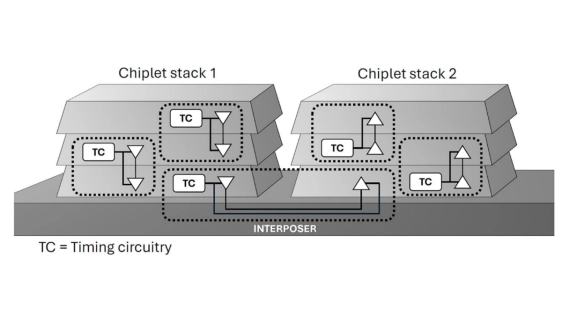
Heterogeneous systems require robust and universal interfaces for die-to-die communication. Industry communication protocols, such as UCIe and Bunch of Wires, provide robust, high bandwidth die-to-die communication for a wide range of technologies. These interfaces include dedicated delay locked loops (DLLs), duty cycle correctors, and deskew circuits at each interface to ensure timing reliability. As the number of dies, or chiplets, within these systems grows, the number of heterogeneous interfaces increases, requiring significant resources. A shared timing approach is presented, where a set of timing circuits provides a clock signal for multiple interfaces, reducing the need for additional circuitry. Clock signal inversion substitutes for the DLLs within the single data rate interfaces to provide a temporal shift to improve reliability. The accumulated jitter along the clock signal path as the signal traverses multiple interfaces is quantified for a 7 nm CMOS process technology. Each interface contributes 2 to 5 ps of RMS jitter. This shared timing approach can be adopted for physically close interfaces with low bandwidth requirements and high noise tolerance to remove the need for DLLs and DCCs at each interface.
To read the full article, click here
Related Chiplet
- FlexGen Multi-Die Smart Network-on-Chip (NoC) IP
- Ncore Multi-Die Interconnect IP
- Integrated voltage regulator (IVR) chiplet
- High-performance connectivity chiplets
- eFPGA Chiplet
Related Technical Papers
- Single chiplet type versus multiple chiplet types per wafer methods
- Optimized Low Parasitic Capacitance ESD Clamps for High-Bandwidth 2.5D/3D Chiplet Interfaces in Advanced FinFET Technology
- System-Level Validation Across Multiple Platforms to build a Robust 2.5D Multi Foundry Chiplet Solution
- Resister: A Resilient Interposer Architecture for Chiplet to Mitigate Timing Side-Channel Attacks
Latest Technical Papers
- Divide and conquer: Scalable performance and energy in MCM GPUs
- A Composable AI-Accelerated Iterative Solver for 3D-IC Thermal Modeling
- QBX: A Compiler for 2-local Qubit Hamiltonian Simulation on Quantum Chiplets
- U-Can-Inject-Errors (UCIe): A Protocol-Aware Hardware Trojan for FPGA Chiplet Links
- The Power of Indirection: Scaling Switches Beyond Silicon Boundaries