To Scale Up or To Scale Out: Evaluating Space-Time Costs of Compiled Logical Circuits on Modular Superconducting Quantum Processors
By Nikiforos Paraskevopoulos 1, Sebastian de Bone 1, Mick Christophersen 2, Simon Storz 3,4, A. Mert Bozkurt 2, Arno Bargerbos 2, and Sebastian Feld 6,7
1 Dark Qore, Poortweg 4, 2612 PA Delft, The Netherlands
2 QuantWare, Molengraaffsingel 8, 2629 JD Delft, The Netherlands
3 Department of Physics, ETH Zurich, 8093 Zurich, Switzerland
4 Quantum Center, ETH Zurich, 8093 Zurich, Switzerland
6 Quantum and Computer Engineering Department, Delft University of Technology, 2628 CD Delft, The Netherlands and
7 QuTech, Delft University of Technology, 2628 CJ Delft, The Netherlands
Abstract
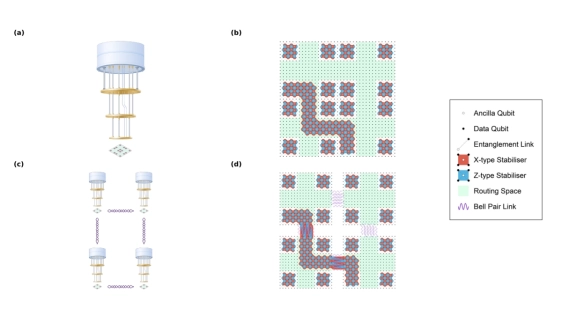
Modular integration has emerged as the main pathway for scaling superconducting quantum processing units (QPUs) beyond the constraints of fabrication yield and physical footprint. Currently, two primary strategies lead this effort. Mirroring the "Scaling Up" and "Scaling Out" approaches in GPU architectures and AI infrastructures, these are: chiplet-based scaling, which preserves dense connectivity and high gate fidelity at the expense of engineering complexity, and distributed architectures, which decouple system scaling from monolithic QPU advancements at the expense of sparser connectivity and lower interconnect quality. To evaluate these approaches, we introduce a quantitative stress test measuring the execution cost of a dense workload of random logical entangling operations using a surface code scheme. Using a dedicated compiler, we compute the space-time cost as the number of network nodes increases, analysing this scaling behaviour across various surface code distances, Bell-state fidelities, and Bell-pair generation times. We find that distributed architectures incur an up to exponential space-time performance penalty compared to an effectively monolithic architecture across all simulations. Our results also show that as the network grows, this penalty manifests in two distinct scaling regimes: a noise-dominated regime constrained by insufficient Bell-state fidelity and generation rates, and a connectivity-dominated regime bottlenecked by lattice-surgery routing congestion.
To read the full article, click here
Related Chiplet
- Optical Chiplet
- Reverse Gearbox Chiplet
- FlexGen Multi-Die Smart Network-on-Chip (NoC) IP
- Ncore Multi-Die Interconnect IP
- Integrated voltage regulator (IVR) chiplet
Related Technical Papers
- MECH: Multi-Entry Communication Highway for Superconducting Quantum Chiplets
- Codesign of quantum error-correcting codes and modular chiplets in the presence of defects
- Modular Compilation for Quantum Chiplet Architectures
- Optimizing Inter-chip Coupler Link Placement for Modular and Chiplet Quantum Systems
Latest Technical Papers
- Embodied Emissions of 2.5D and 3D Scaling in Chipletized GPUs for Low-Carbon AI
- Adaptive 3D Chiplet Architecture with Hybrid Wired–Wireless Interconnect for Energy-Efficient Heterogeneous Computing
- LLM-Augmented Bayesian Optimization with Adaptive Policies for Chiplet Design Space Exploration
- Divide and conquer: Scalable performance and energy in MCM GPUs
- A Composable AI-Accelerated Iterative Solver for 3D-IC Thermal Modeling